
Fall menu ideas give foodservice operators an opportunity to lean into the flavors, comfort foods, and seasonal favorites guests crave as the weather cools down.
Fall has a way of changing what people want to eat. The weather cools down, routines settle back in, and suddenly soups, hearty entrées, warm desserts, and seasonal drinks sound a lot more appealing.
For foodservice operators, though, putting those flavors on the menu is only part of the job.
A restaurant may be trying to introduce a few seasonal specials without adding hours of prep. A hotel could be planning fall banquet menus while also feeding breakfast guests and running room service. Casinos have multiple outlets and dayparts to think about, while senior living, healthcare, education, and other foodservice operations have their own demands around consistency, volume, and cost.
Whatever the segment, the question is similar: How do you make a fall menu feel fresh and seasonal without making the operation more complicated?
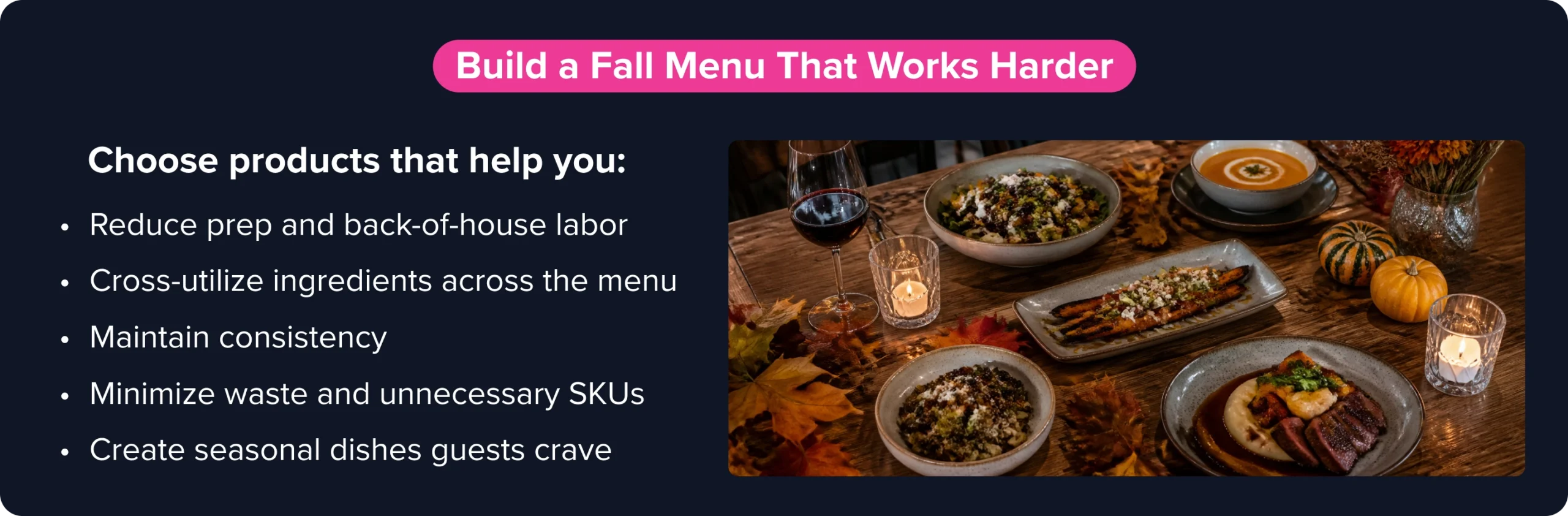
It starts with being selective. The best fall menu ideas aren’t necessarily the ones with the most ingredients or the most elaborate preparation. They’re the ones that give guests something they want while making sense for the people who have to order, prep, cook, and serve it.
Beyond Pumpkin Spice: The Real Challenges of Fall Menu Planning
Pumpkin spice may get most of the attention, but operators know there’s much more behind a successful seasonal menu.
Before adding another soup, entrée, side, or specialty drink, you have to consider whether your kitchen can execute it consistently, whether the ingredients fit the budget, and whether guests will actually order it.
Labor shortages and the need for operational efficiency
A menu can look fantastic during development and become a completely different story during service.
Every ingredient that needs to be peeled, chopped, portioned, simmered, or prepared from scratch adds another task for the kitchen. When teams are already stretched, those extra steps add up quickly.
That doesn’t mean scratch-inspired food has to disappear. It means operators have to be more intentional about where labor is spent.
A prepared stock could eliminate hours of simmering. A ready-to-use potato product can take several prep steps off the list. A pre-portioned protein may help the line move faster while improving portion consistency.
Those decisions can give cooks more time to focus on the parts of a dish where their skill makes the biggest difference.
Rising food costs and margin protection
Seasonal dishes still have to earn their place on the menu.
When ingredient prices move, even small changes can affect the profitability of an item. That’s especially true when a seasonal dish brings several new ingredients into the operation that aren’t being used anywhere else.
Operators need to look beyond the case price and consider yield, waste, portion size, prep requirements, shelf life, and how many different menu items can use the same product.
Sometimes the smarter choice isn’t the ingredient with the lowest upfront cost. It’s the one that can be used more efficiently across the operation.
Evolving guest expectations for seasonal, craveable comfort foods
Guests still want fall to feel like fall.
They want creamy soups, savory proteins, hearty potatoes, apples, baked desserts, warm spices, and hot drinks. But seasonal doesn’t have to mean predictable.
A hotel might work apple into a breakfast offering and later use it in a banquet dessert. A restaurant could turn a rich stock into both a soup and a pan sauce. A casino could use the same protein across a breakfast concept, casual dining outlet, and late-night menu.
The opportunity is to give guests those familiar fall cues in ways that work harder behind the scenes.
Smart Ingredients & Products That Simplify Seasonal Menu Development
One of the easiest ways to simplify fall menu ideas is to start with ingredients that solve more than one problem.
Products that reduce prep, perform consistently, and work across several applications can give operators more room to create without filling the walk-in with ingredients that only have one job.
Rich bases, broths, and stocks for fast flavor foundations
Soups, gravies, sauces, braises, and casseroles all benefit from a flavorful foundation. Making that foundation entirely from scratch, however, can require hours of prep and valuable equipment space.
Foodservice solutions from Campbell’s, Custom Culinary, and Nestlé Professional’s Minor’s® line can help kitchens build rich, seasonal flavor more efficiently.
Bases, broths, sauces, gravies, and flavor concentrates can give operators flexible building blocks for fall menus without requiring every component to start from scratch. A rich flavor foundation might become the starting point for a seasonal soup, gravy, braising liquid, or sauce, giving kitchens more ways to create comforting cold-weather dishes while keeping preparation manageable.
That flexibility is particularly valuable in high-volume operations where consistency matters just as much as speed.
Comforting, low-labor sides and potato solutions
Few ingredients say comfort food quite like potatoes.
Mashed potatoes alongside roasted meat, crispy potatoes with breakfast, loaded potato applications, hearty bowls, and shareable sides all fit naturally into fall menus.
Solutions from Idahoan Foodservice and McCain Foodservice can help operators bring those familiar favorites to the menu while reducing some of the washing, peeling, cutting, cooking, and other preparation associated with potatoes.
For a busy kitchen, banquet operation, buffet, or multi-unit concept, removing even a few prep steps can make a meaningful difference. For more ideas on getting greater versatility from a familiar menu staple, explore why mashed potatoes belong on more menus across foodservice and how operators are using them to reduce prep, improve consistency, and create opportunities across multiple dayparts.
Versatile proteins for harvest entrées and breakfast items
Proteins are often where fall menus start to feel especially hearty, but they can also represent a significant portion of both food cost and kitchen labor.
Hormel Foodservice and Smithfield offer protein solutions that can help operators build dishes across multiple dayparts and menu formats.
Think sausage incorporated into a breakfast bowl, pork paired with an apple-forward sauce, ham used for breakfast and sandwiches, or a prepared protein incorporated into a seasonal entrée.
When one protein has several potential applications, operators have more opportunities to use inventory efficiently rather than bringing in a product for one limited-time dish.
Seafood options that bring seasonal variety without kitchen complexity
Fall menus don’t have to be built entirely around heavier meats.
Seafood can give guests another option while still fitting comfortably into the season. Chowders, seafood sandwiches, fish entrées, bowls, and crispy seafood applications can provide variety alongside more traditional fall offerings.
High Liner Foods offers foodservice seafood solutions that can help simplify preparation and portioning, making it easier for operators to introduce seafood without adding unnecessary complexity to the kitchen. For operators looking to balance seafood variety with tighter labor, inventory, and cost control, learn more about why seafood still belongs on the menu and how frozen and versatile seafood products can support a more manageable program.
Creamy dairy applications for soups, sauces, and baked dishes
Dairy plays a starring role in many of the dishes people crave once temperatures drop.
Cheese can add richness to a baked pasta. Creamy ingredients can transform a soup or sauce. Butter and cheese can bring familiar comfort to potatoes, vegetables, sandwiches, and breakfast dishes.
Products from Lactalis give operators options for building those rich fall applications while maintaining consistency across batches and locations.
The bigger opportunity is cross-utilization. Rather than bringing in a dairy product for one recipe, look for applications that allow it to move across several parts of the menu.
Orchard-fresh apple products, fruit fillings, and dessert toppings
Apples practically come with their own fall marketing campaign.
But there’s a difference between wanting apple on the menu and wanting someone in the kitchen to peel, core, slice, and prep case after case of fresh fruit.
Solutions from Knouse Foods, including Musselman’s and Lucky Leaf, can make it easier to incorporate apple and other fruit flavors into seasonal menus.
And don’t stop at pie. Apple products can work in breakfast dishes, parfaits, baked goods, desserts, sauces, toppings, and savory applications alongside pork or other proteins.
One ingredient can suddenly have a lot more range.
Ready-to-serve bakery and dessert solutions guests crave
A warm dessert can be the perfect ending to a fall meal. It can also be one more thing a short-staffed kitchen doesn’t have time to produce completely from scratch.
Foodservice bakery and dessert solutions from Rich’s and Sara Lee can help operators add indulgent seasonal options with fewer preparation requirements.
Operators can also make prepared desserts their own through plating, sauces, fruit toppings, garnishes, or seasonal accompaniments. Guests get an experience that feels special without the kitchen taking on an entirely new baking operation.
Dependable hot beverage packaging for on-trend seasonal drinks
Fall isn’t only a food occasion.
Coffee, cider, hot chocolate, seasonal lattes, and other warm beverages create opportunities across restaurants, hotels, cafés, convenience operations, campuses, and grab-and-go environments.
But the drink needs to make it from the counter to the guest in good shape.
Dart SOLO® Paper Hot Cups & Lids provide foodservice operators with packaging designed for hot beverage service, helping support seasonal beverage programs across dine-in, takeaway, and on-the-go occasions.
Independent restaurants click here to learn more about Dart’s foodservice packaging solutions and request a free sample to see if they’re the right fit for your operation.
Practical foil solutions for seasonal prep, cooking, and service
Fall menus often come with more roasting, baking, holding, and transporting, making dependable back-of-house supplies just as important as the ingredients themselves.
Daxwell aluminum foil products, wraps, and pans can help operators manage seasonal preparation and service more efficiently. From roasting proteins and vegetables to baking pies and quiches or keeping prepared foods warm, versatile foil solutions can support busy kitchens, catering programs, banquets, and other high-volume fall occasions.
It’s a simple operational detail, but having the right supplies on hand can make it easier to move food from prep to service while maintaining quality and reducing unnecessary cleanup.
Technology & Tools That Streamline Menu Execution
The ingredient list is only one piece of the seasonal menu puzzle.
Operators also need to know what is selling, what’s sitting on the shelf, what needs to be reordered, and where costs may be drifting away from plan.
Digital inventory and forecasting to reduce waste
Seasonal ingredients can be difficult to forecast because operators don’t always have a full year of demand history for a new dish or LTO.
Digital inventory and forecasting tools give teams better visibility into what they’re actually using.
If a seasonal soup isn’t moving as quickly as expected, purchasing can adjust before cases start stacking up. If a fall special takes off, operators can respond sooner instead of finding out when the kitchen is already running short.
Better visibility makes seasonal planning less of a guessing game.
Choosing ingredients that cross-utilize across multiple dayparts
One of the best questions to ask during menu development is simple:
Where else can we use this?
An apple filling might work at breakfast and dessert. A protein could move from a morning sandwich into a lunch entrée. A stock could support soup, gravy, and sauce. Potatoes can appear in breakfast, lunch, dinner, catering, and banquet applications.
The more work an ingredient can do, the easier it becomes to justify adding it to the operation.
Reducing SKU complexity while maintaining consistent quality
More fall menu ideas don’t necessarily require more SKUs.
In fact, some of the strongest seasonal menus are built around a relatively small group of versatile products.
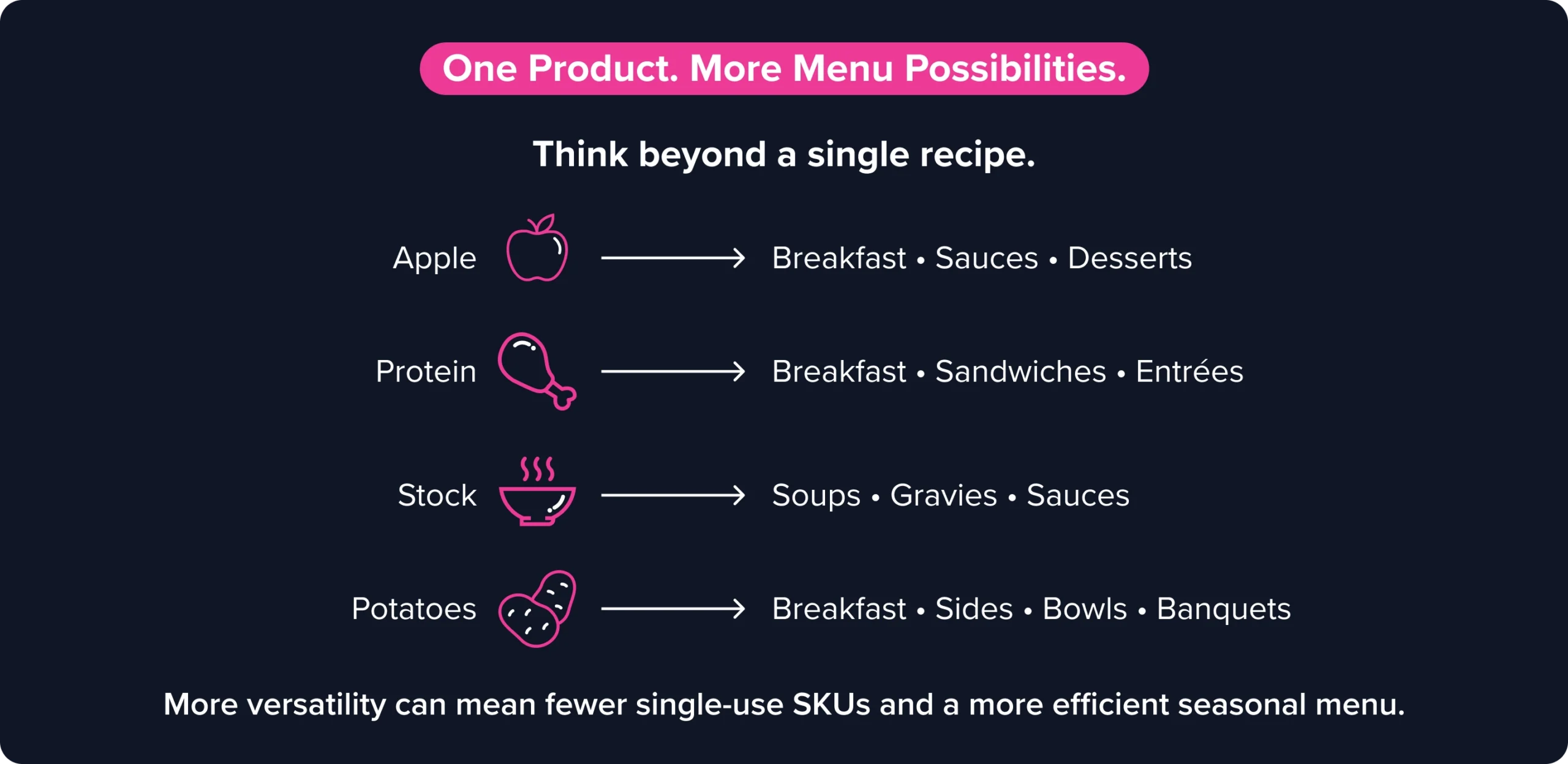
Reducing unnecessary SKU complexity can make ordering, storage, inventory counts, training, and execution easier. For multi-location restaurant groups, hotels, casinos, healthcare organizations, and other large operations, it can also make consistency easier to maintain from one kitchen to the next.
The Missing Piece: Why Partnering With the Right Suppliers Matters
A great fall menu doesn’t exist in isolation. There is an entire supply chain behind every plate.
Choosing the right products matters, but so does choosing manufacturers and supplier partners that understand the realities of foodservice.
How trusted manufacturers help reduce operational risk
Seasonal menus have a relatively short window to succeed. Operators don’t have much room for unreliable products, inconsistent specifications, or supply issues.
Working with established foodservice manufacturers can give operators greater confidence in product performance and availability.
That reliability matters whether you’re trying to keep the same dish consistent across 50 restaurant locations or make sure a hotel banquet for 500 guests goes exactly as planned.
Why product consistency and versatility are non-negotiable in seasonal planning
Consistency affects much more than the guest experience.
When a product performs differently from one case to another, kitchens may have to adjust recipes, portions, cooking times, or preparation methods. That creates extra work and makes costs harder to control.
Versatility matters for many of the same reasons. A product that can move across several recipes or dayparts gives the operation more ways to use what it purchases.
For seasonal planning, those two qualities can be just as important as flavor.
How Buyers Edge Platform Empowers Smarter Seasonal Menu Planning
Fall menu planning involves a lot of moving pieces, but operators don’t have to manage all of them alone.
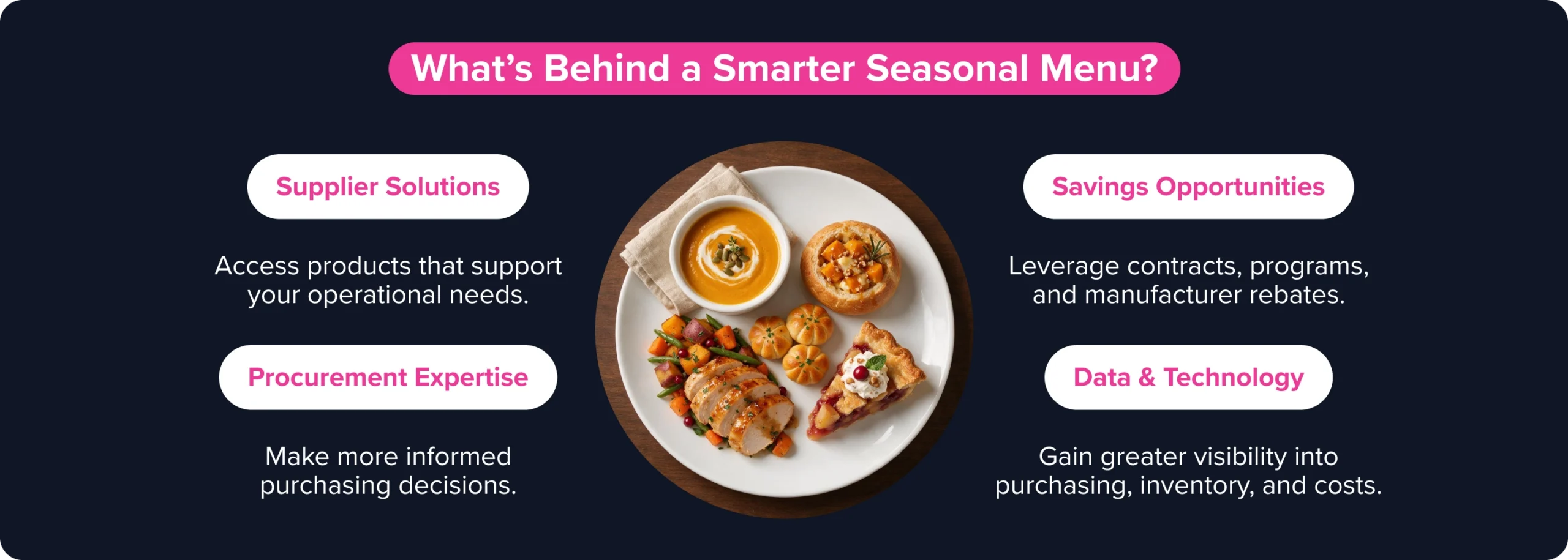
Buyers Edge Platform brings together procurement expertise, supplier relationships, technology, and savings opportunities to help foodservice organizations make smarter purchasing decisions across their operations.
Access to a curated network of trusted foodservice supplier solutions
Finding the right product is easier when you already have access to the right network.
Through Buyers Edge Platform, foodservice operators can connect with supplier solutions across food, beverage, disposables, and other categories needed to run their businesses. That network can also make it easier to bring new menu ideas to life. Learn more about the power of the right partners behind menu innovation and how strong manufacturer, supplier, and service provider relationships can help operators turn ideas into executable menu offerings.
That means a restaurant developing a few fall LTOs, a hotel preparing for banquet season, a casino managing several concepts, or a healthcare or senior living operation planning hundreds of meals can approach purchasing with more resources at their disposal.
Leveraging procurement expertise and manufacturer rebates to protect margins
A seasonal menu may only last a few months. The purchasing decisions behind it can still have a significant financial impact.
Buyers Edge Platform helps operators uncover savings opportunities through manufacturer programs, rebates, contracts, and procurement expertise.
That creates another lever for managing costs beyond simply raising menu prices or choosing the cheapest available ingredient.
The goal is to look at the bigger purchasing picture and find opportunities to get more value from the products the operation already needs.
A streamlined way to maintain high quality while managing costs and complexity
Operators shouldn’t have to choose between serving food they’re proud of and running an efficient business.
The right combination of supplier relationships, purchasing strategies, data, and technology can make it easier to do both.
Buyers Edge Platform helps foodservice organizations gain greater visibility into purchasing, uncover savings opportunities, and connect with solutions that support their operational needs. That can mean less time chasing down purchasing problems and more time focused on the guest experience.
Build a Fall Menu That Works Harder So You Don’t Have To
The best fall menu isn’t necessarily the one with the most seasonal dishes. It’s the one your operation can execute well, repeatedly, and profitably.
Start with strategy, not just seasonal trends
Before adding a dish because it feels like fall, look at what it will require from the operation.
Does it fit your guests? Can existing ingredients support it? Will it create unnecessary SKUs? How much prep does it add? Can your team execute it during the busiest service of the week?
Those questions may not be as fun as deciding between apple and pumpkin, but they usually lead to a stronger fall menu ideas.
Equip your kitchen with the right labor-saving products
Convenience doesn’t have to mean compromise.
Strategically chosen labor-saving products can remove repetitive prep, improve consistency, reduce waste, and give culinary teams more time for the work that actually needs their attention.
Use prepared components where they make sense. Put labor into the details guests notice. And build seasonal dishes around ingredients that can earn their keep across the menu.
Let Buyers Edge Platform be your ultimate ally in seasonal success
Smarter fall menu ideas start long before the first plate reaches the table.
It starts with what you purchase, who you purchase it from, how efficiently you use it, and whether every ingredient is helping the operation deliver the quality guests expect at a cost the business can sustain.
Buyers Edge Platform helps restaurants, hotels, casinos, healthcare organizations, senior living communities, and other foodservice operators connect the dots between procurement, savings, supplier solutions, and operational efficiency.
Because when your ingredients, partners, and purchasing strategy are all working together, fall can be about creating something guests can’t wait to order, not creating more work for your team.
Ready to make your seasonal purchasing strategy work harder? Click here to contact Buyers Edge Platform and learn more about how we can help you uncover savings and simplify procurement across your operation.