Food distribution technology has become essential as food distribution grows increasingly complex. Distributors are managing larger product catalogs, tighter delivery windows, rising operating costs, increasing customer expectations, and growing pressure to make faster decisions across every part of the business.
At the same time, many organizations are still relying on disconnected systems and manual processes that make it difficult to maintain visibility across inventory, procurement, logistics, and customer operations. Those gaps create inefficiencies that affect service levels, profitability, and long-term growth.
That’s why food distribution technology has become a competitive advantage rather than simply an operational upgrade. Modern technology gives distributors the visibility, automation, and data they need to streamline operations, improve decision-making, and build more resilient supply chains. In this guide, we’ll explore how technology is transforming the food distribution industry and where it’s delivering the greatest impact
Why Food Distribution Is Becoming More Complex
Let’s face it, the landscape for foodservice distributors has changed dramatically. We’re dealing with more SKUs than ever before, a wider variety of delivery needs (think direct-to-consumer alongside traditional restaurant drops), and a constant pressure to reduce waste and spoilage. Add in the complexities of food safety regulations and the need for traceability, and you’ve got a recipe for a very intricate operation. Distribution used to be simpler: buy product, move it, sell it. Now many variables are stacked into a single delivery. Rising SKU counts and specialized product lines (ethnic, organic, allergen-free), multi-temperature handling, tighter shelf-life windows, and on-demand ordering from operators have all intensified complexity. Add in spotty supplier data, different order channels, and tight margins, and you’ve got an environment where manual processes break down fast.
How Disconnected Systems Limit Visibility and Control
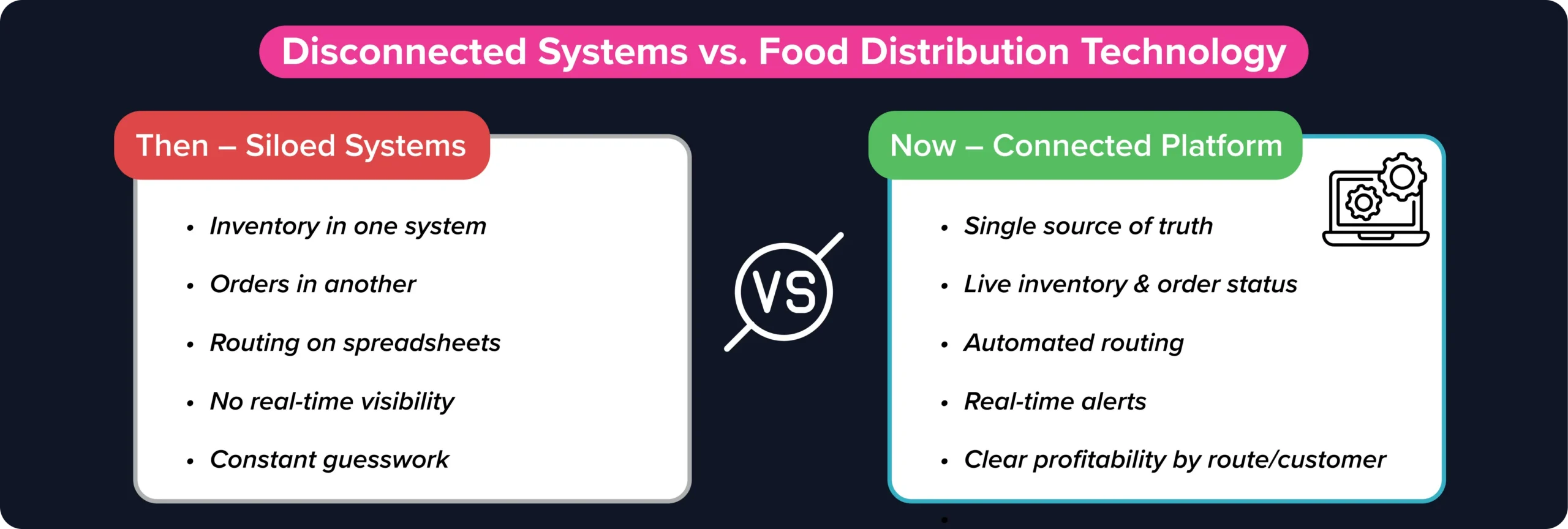
For a long time, many of us operated with systems that didn’t talk to each other. You had your inventory system, your order entry, your delivery schedule – all separate. This meant limited visibility. You might not know exactly what was on hand in the warehouse until it was time to pick an order, or you might not have a clear picture of your delivery fleet’s status. When inventory, orders, invoicing, and routing live in different systems (or worse, in spreadsheets), gaps appear. You lose real-time visibility into what’s in stock and what you’ve committed to customers. That creates stockouts, overpicks, wasted product, and costly last-minute rushes. Disconnected systems also make it nearly impossible to reconcile costs across purchase orders, freight, and shrink — so measuring true profitability by customer or route becomes a guessing game. Food distribution technology closes these gaps by centralizing data and creating a single source of truth.
Where Technology Is Changing Daily Distribution Operations
This is where food distribution technology is making its biggest splash, right where the rubber meets the road – or the truck meets the dock! The tools that used to be reserved for the biggest national players are now within reach for regional and independent distributors too.
Managing Inventory with Real-Time Visibility
Remember the days of manual inventory counts and educated guesses? Modern food distribution technology, especially warehouse management systems (WMS), gives you real-time visibility into your stock. You know exactly what you have, where it is, and when it’s nearing its expiration date. This precision helps cut down on waste and ensures you’re always fulfilling orders with what’s actually available. Modern inventory systems give you a live look at what’s in the warehouse, what’s coming in, and what’s going out. No more end-of-day reconciliations to figure out what you actually have. Scanners, sensors, and integrated WMS platforms mean a case picked at 10 AM is reflected in your numbers by 10:01.
Streamlining Order Processing and Fulfillment
From the moment an order comes in, technology can speed things up. Integrated order management systems capture orders from various channels, automate data entry, and send them directly to the warehouse floor. This reduces errors, speeds up picking and packing, and ultimately gets products out the door faster. Order workflows used to be manual phone calls, faxes, and handwritten invoices. Modern food distribution technology automates order capture from EDI, web portals, and mobile apps, validates availability, applies pricing rules, and queues orders for picking. The result is fewer errors, faster fulfillment, and better customer communications.
Optimizing Delivery Routes and Logistics
Getting products to customers on time and efficiently is critical. Route optimization software uses algorithms to plan the most efficient delivery paths, considering traffic, delivery windows, and vehicle capacity. This not only saves on fuel costs but also improves delivery times and customer satisfaction. It’s a prime example of how food distribution technology impacts your daily logistics. Routing technology has gotten really good. Software can now factor in traffic, delivery windows, truck capacity, driver hours, and even the layout of a customer’s loading dock to build routes that save real money. Distributors using modern routing tools are pulling fuel costs down, fitting in more stops per day, and getting product to customers earlier in the morning.
Improving Coordination Across Suppliers and Customers
Technology acts as a central hub, facilitating better communication. Electronic data interchange (EDI) or supplier portals can automate purchase orders and invoices, while customer portals can give clients visibility into their orders and delivery status. This seamless flow of information strengthens relationships all around. When your systems can talk to your suppliers’ systems and your customers’ systems, the whole chain runs smoother. Suppliers know what you need before you have to ask. Customers can check order status without picking up the phone. Everybody’s working off the same information, which means fewer surprises.
How Technology Is Changing Distributor Decision-Making
Beyond the day-to-day operations, food distribution technology is revolutionizing how we make strategic decisions. It’s moving us from gut feelings to data-driven strategies. Technology changes decisions from gut-based to data-backed. Instead of guessing which product to push or which route is profitable, leaders can model outcomes and prioritize resources. When your team sees real-time margins, waste trends, and service metrics in one place, conversations change: they’re focused on improvement instead of firefighting. Food distribution technology isn’t just about operations — it’s about empowering smarter leadership.
How Data Is Used to Make Better Distribution Decisions
The amount of data generated by modern food distribution technology is astounding. The key is to turn that raw data into actionable insights. Every order, every delivery, every inventory adjustment creates data. When you have the right systems in place, this data can be analyzed to reveal trends, identify bottlenecks, and highlight areas for improvement you might never have spotted otherwise. Data is the word everyone throws around, but most distributors are sitting on mountains of it without doing much with it. The shift happening right now is turning that data into something useful.
Turning Everyday Data into Actionable Insights
Every scan, invoice, and delivery is a data point. Food distribution technology collects that data and turns it into dashboards and alerts you can act on — like noticing a pattern of short-picks on a specific SKU, or a recurring late delivery on a particular route. Those insights guide targeted fixes: retraining pick teams, adjusting par levels, or changing route schedules.
Understanding Demand Across Products and Locations
Knowing what your customers want, and where they want it, is one of the biggest advantages technology provides. Demand forecasting tools analyze historical sales data, market trends, and external factors like weather or local events to help distributors anticipate future demand. That visibility makes it easier to stock the right products in the right quantities while reducing both stockouts and excess inventory.
Building accurate forecasts, however, requires more than looking at historical sales alone. Purchasing patterns, supplier lead times, inventory movement, and regional demand all influence what products will be needed next. Our guide to food demand forecasting explores how distributors can combine these data points to improve planning accuracy and make more informed purchasing decisions.
Demand isn’t uniform. A product that moves quickly in one market may sit on the shelf in another. Technology makes those differences easier to identify by providing visibility at the product, region, customer, and even day-of-week level. Those insights help distributors make smarter inventory decisions, strengthen supplier planning, and better serve customers across every market they support.
Identifying Inefficiencies and Hidden Costs
Are your delivery costs higher than they should be? Is a particular warehouse process taking too long? Data analytics, powered by food distribution technology, can pinpoint these inefficiencies and hidden costs, allowing you to take targeted action to improve profitability. Every operation has leaks. The drivers who consistently run over hours. The accounts that take six weeks to pay. The SKUs that have a five percent shrink rate nobody noticed. The tech surfaces all of that. Once you can see it, you can fix it. Or at least decide what’s worth fixing.
Technologies Used in Food Distribution Today
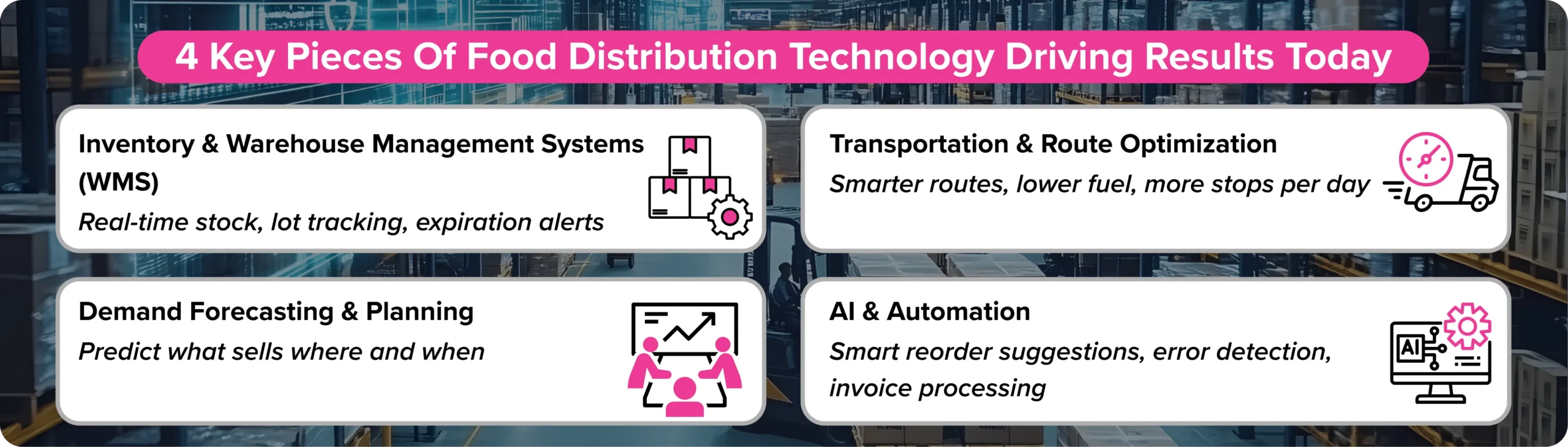
So, what are these transformative technologies we’re talking about? If you’re trying to figure out where to start, here’s a quick lay of the land on the food distribution technology that’s making the biggest difference right now.
Inventory and Warehouse Management Systems
These systems are the backbone of efficient warehousing. They track inventory levels, manage stock locations, and streamline picking, packing, and shipping processes. WMS platforms are the backbone. They track product from the moment it hits your dock until it leaves on a truck. The newer ones handle lot tracking, expiration dates, temperature zones, and slotting optimization without breaking a sweat. If your warehouse is still running on paper pick sheets, this is probably where you start.
Transportation and Route Optimization Tools
Essential for the logistics side of things, these tools ensure your fleet is used to its maximum potential, saving time and money on deliveries. From simple multi-stop optimizers to dynamic route planners with live traffic and proof-of-delivery integration, these tools reduce miles and time on the road. The best solutions also handle capacity planning and driver productivity metrics so you’re not just saving fuel — you’re improving service and lowering overall delivery cost.
Demand Forecasting and Planning Systems
Crucial for managing inventory and avoiding waste, these systems help predict what will sell and when. Forecasting tools blend history, event signals, and local knowledge to produce replenishment suggestions and safety stock recommendations. Integrated planning systems close the loop by translating forecasts into purchase recommendations that respect supplier lead times and minimum order quantities. Forecasting used to be a guy with a spreadsheet and some intuition. Now it’s algorithms looking at historical sales, weather patterns, local events, menu trends, and a dozen other factors to predict what you’re going to need. It’s not perfect, but it’s a heck of a lot better than guessing.
AI and Automation in Distribution
Artificial intelligence (AI) and automation are increasingly playing a role, from optimizing warehouse robots to powering smarter forecasting algorithms and even improving customer service with chatbots. AI is the buzzword right now, and a lot of it is overhyped. But some of the practical applications are genuinely changing things. Automated invoice processing. Smart reorder suggestions. Chatbots that handle routine customer service questions. Vision systems that catch picking errors before they leave the warehouse. The stuff that works tends to be quiet, focused on specific problems, and saves real hours every week.
How Technology Affects Cost, Efficiency, and Performance
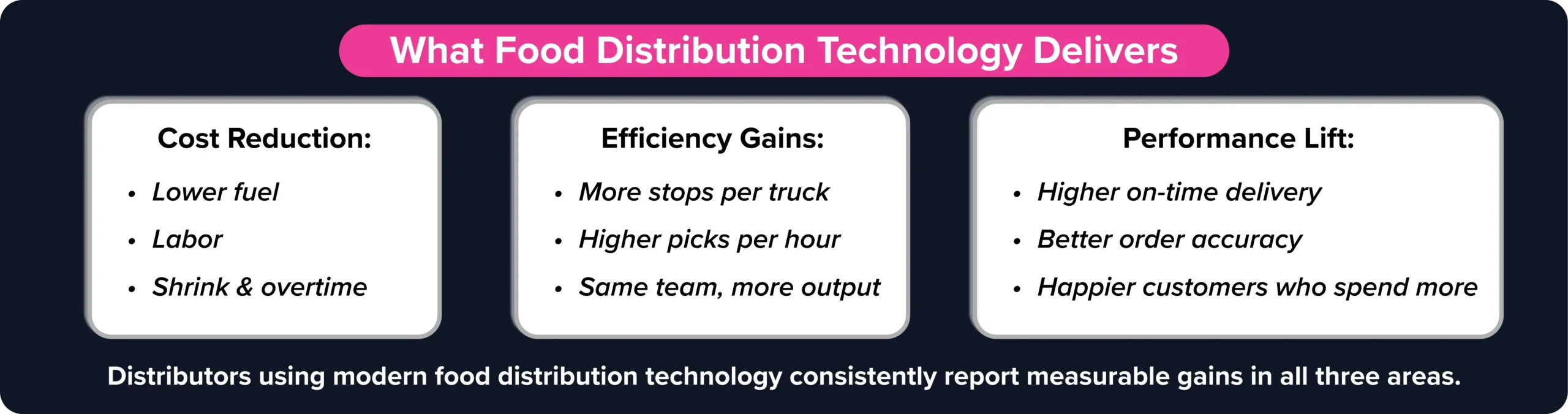
At the end of the day, investing in food distribution technology is about tangible results. You’ll see reduced operational costs through optimized routes and less waste. Efficiency will skyrocket as processes become more streamlined and automated. Overall performance will improve with better inventory management, faster fulfillment, and happier customers. Let’s talk numbers, because at the end of the day that’s what matters.
Distributors who’ve invested seriously in food distribution technology generally report meaningful improvements in three areas. Costs go down. Fuel, labor, shrink, and overtime all tend to drop once you can actually see where the money is going. Efficiency goes up. Trucks make more stops. Pickers fill more orders per hour. Customer service handles more accounts without adding headcount. The same team gets more done because the technology takes the friction out of the work. Performance metrics improve across the board. On-time delivery rates climb. Order accuracy gets better. Customer satisfaction scores tick up because customers stop dealing with the little annoyances that used to drive them crazy. And when customers are happy, they stay, and they spend more. That’s how it should work.
Barriers to Technology Adoption in Food Distribution
We know that adopting new technology isn’t always easy. Some common hurdles include the initial investment cost, the need for employee training, integrating new systems with existing ones, and sometimes, just the general resistance to change. So if all this is so great, why hasn’t every distributor jumped on it? Fair question. There are real barriers, and it’s worth being honest about them. Cost is the obvious one. Good technology isn’t cheap upfront, even though it pays back over time.
For a distributor running on thin margins, writing a six-figure check for new software is a big ask. Change management is the bigger issue, honestly. Your warehouse team has been picking orders the same way for fifteen years. Your drivers have their own routes they swear are the most efficient. Asking everyone to adopt a new way of working is hard, and a lot of tech projects stall not because the software was bad but because the team never fully bought in. Integration is the other quiet killer. New systems have to play nice with the old ones, at least during the transition, and that’s where a lot of implementations get ugly. Pick the wrong platform or the wrong partner, and you can end up worse off than where you started. However, the long-term benefits of food distribution technology often far outweigh these initial challenges.
How Buyers Edge Platform Supports Technology-Driven Distribution
At Buyers Edge Platform, we understand the pressures and complexities you face. That’s why we’re committed to helping you navigate the world of food distribution technology. We work to provide solutions and insights that empower you to leverage technology effectively, from streamlining your procurement processes to offering expertise that can guide your technology adoption journey. We believe in equipping you with the tools and knowledge to thrive in today’s evolving market. This is where we come in. Buyers Edge Platform was built for the foodservice industry, and we’ve spent years working with distributors to figure out what actually moves the needle and what’s just noise. Our platform offers:
- Centralized Data: We aggregate pricing, contract terms, and product spec data into a single place so your procurement and operations teams make decisions from the same truth.
- Procurement Efficiency: Automated sourcing and rebate management help protect margins and reduce manual invoice exceptions.
- Actionable Insights: Our dashboards highlight margin leakage, vendor performance, and category opportunities so you can prioritize where to act.
- Integration-Friendly: Buyers Edge Platform works with your existing WMS, ERP, and routing tools through APIs and standard connectors, minimizing disruption during implementation.
- Ongoing Support: We help with onboarding, data cleanup, and training so your team sees value quickly — not months down the road.
In short, Buyers Edge Platform is designed to make food distribution technology deliver real, measurable improvements in cost, service, and decision-making.
FAQs
What is food distribution technology?
Food distribution technology refers to the software, hardware, and systems used to manage and optimize the processes involved in moving food products from suppliers to end customers. This includes everything from inventory management and order processing to logistics and data analytics. It encompasses the software and tools used to manage the movement, storage, ordering, and sale of food products from suppliers to operators. It includes inventory systems, WMS, route optimization, demand forecasting, procurement platforms, and analytics that help distributors run operations smoothly and profitably.
How is technology transforming food distribution?
Technology is transforming food distribution by increasing efficiency, improving visibility, reducing costs, enhancing customer service, and enabling data-driven decision-making. It automates manual tasks, optimizes complex logistics, and provides insights that were previously unavailable. Technology is bringing automation, visibility, and intelligence to every step of the distribution chain. It reduces manual errors, speeds order-to-delivery cycles, improves traceability, and turns daily operations into measurable processes that can be continuously improved.
What technologies are most important in food distribution?
Key technologies include inventory and warehouse management systems (WMS), transportation and route optimization tools, demand forecasting and planning systems, and increasingly, AI and automation. Key technologies include inventory and warehouse management systems, transportation and route optimization tools, demand forecasting and planning systems, and procurement/analytics platforms. Increasingly, AI and machine learning are layered on top of these systems to surface insights and automate decisions.
How does technology improve efficiency in distribution?
Technology improves efficiency by automating tasks, streamlining workflows, optimizing routes to save time and fuel, reducing errors through digital processes, and providing real-time data for better decision-making, which minimizes waste and delays. By centralizing data, automating repetitive tasks, and optimizing processes like picking and routing, technology reduces labor hours, cuts waste, and improves fill rates. That drives down cost per case and improves customer satisfaction.
What role does AI play in food distribution?
AI plays a growing role in food distribution by enhancing demand forecasting accuracy, optimizing warehouse operations through automation and robotics, improving route planning, and enabling predictive maintenance for fleets, all contributing to greater efficiency and cost savings. AI helps detect demand shifts, recommend optimal reorder points, flag anomalies, and automate pricing or promotions analysis. It accelerates pattern recognition across large datasets so actions can be taken before small issues become big problems.