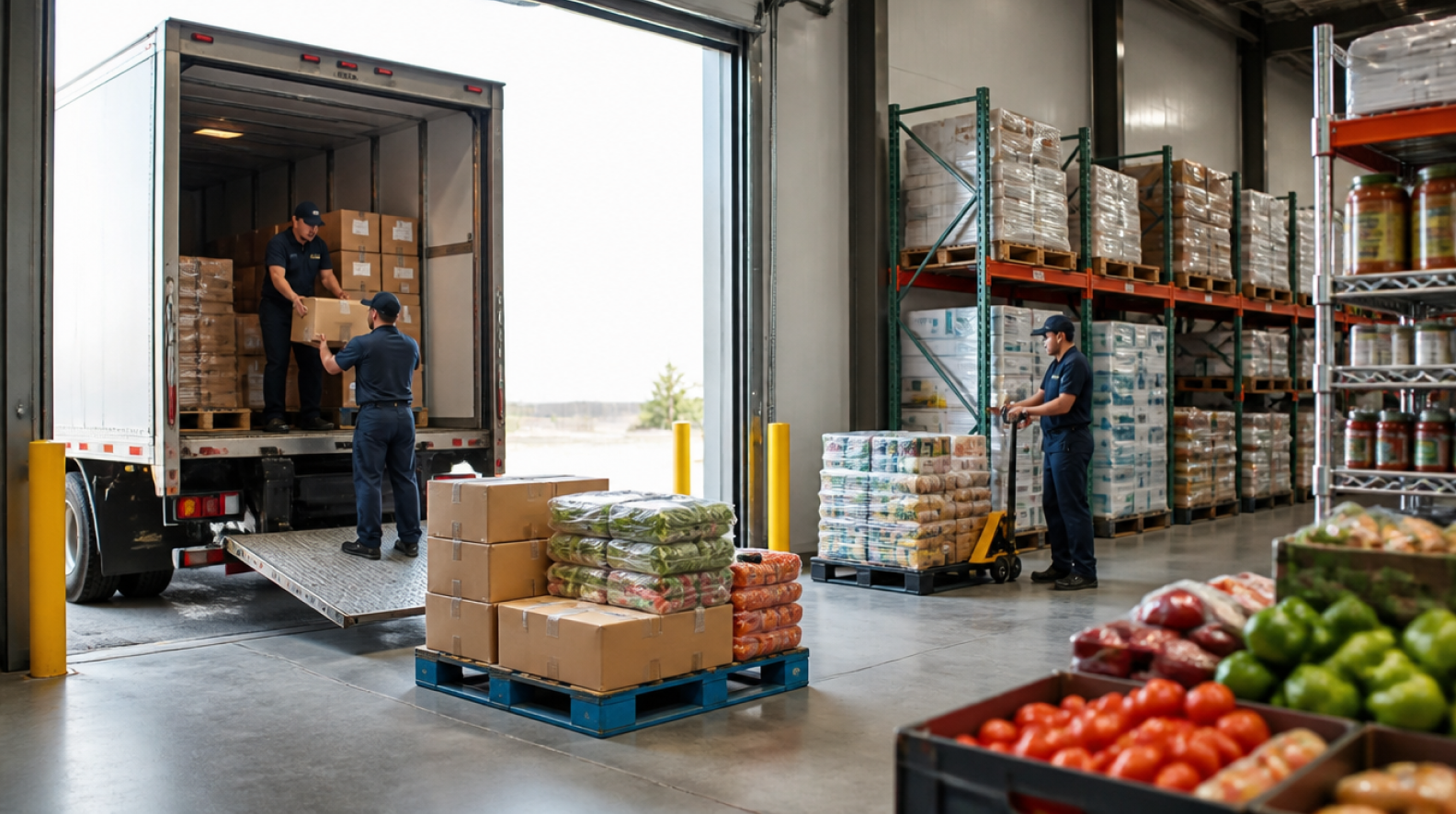
Every meal served outside the home depends on a complex network working behind the scenes. Products must be sourced, stored, sold, transported, and delivered at the right temperature and in the right condition. And, ideally, they arrive before the kitchen realizes how close it came to running out.
That puts food distributors at the center of one of the largest and most operationally demanding supply chains in the country.
This food distribution industry analysis examines the size of the U.S. foodservice distribution market, the companies operating within it, and the trends changing how distributors compete. It also explores a growing business priority: using purchasing and demand data to find profitable opportunities in a market where volume alone does not always tell the full story.
How Big Is the Food Distribution Industry?
The U.S. foodservice distribution industry generates approximately $400 billion in annual sales, according to the International Foodservice Distributors Association. Distributors deliver roughly 12 billion cases to professional kitchens each year, averaging about 33 million cases per day.
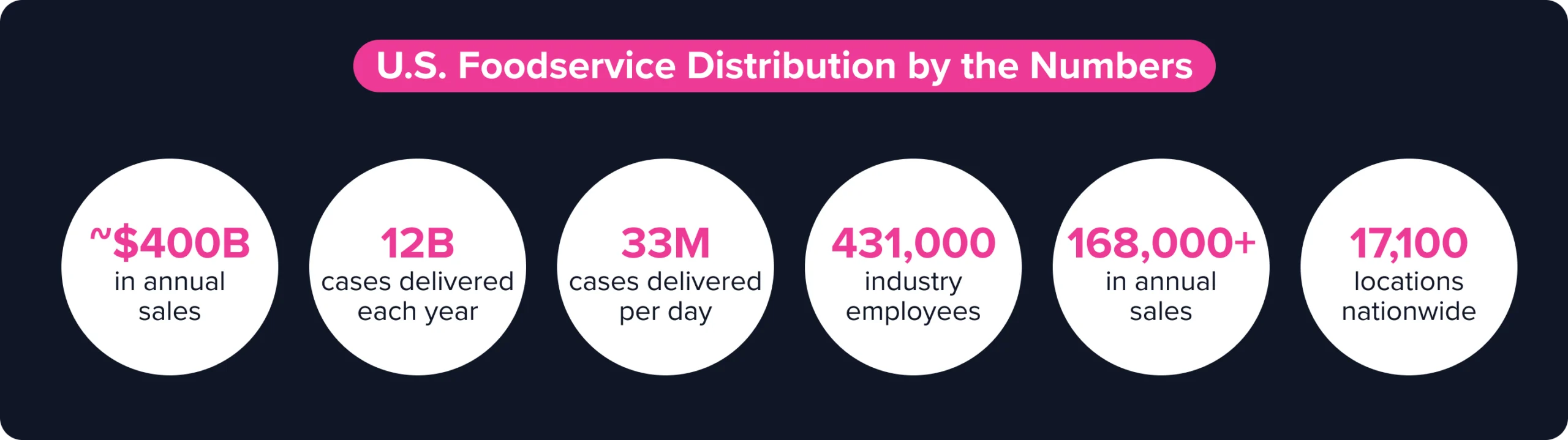
The industry’s footprint stretches far beyond cases and delivery routes. Foodservice distributors employ approximately 431,000 people, operate a combined fleet of more than 168,000 vehicles, and maintain around 17,100 locations across the United States.
Demand comes from a wide range of customers, including:
- Independent and multi-unit restaurants
- Hotels and hospitality groups
- Healthcare and senior living facilities
- Schools, colleges, and universities
- Government and public-sector organizations
- Convenience stores
- Entertainment and recreation venues
- Corporate dining operations
What Types of Food Distribution Companies Operate in the Market?
The market is also supported by a sizable food-away-from-home economy. The USDA Economic Research Service reported that U.S. foodservice outlet sales reached $1.41 trillion in 2025 when expressed in inflation-adjusted 2025 dollars.
The following table provides a snapshot of the industry. Market estimates should be read carefully because sources may measure direct distributor sales, broader economic activity, or customer-level foodservice spending.
| Market statistic | Current indication | What it represents |
|
Market size |
Approximately $482 billion |
Estimated total economic impact of U.S. foodservice distributors, including $382 billion in direct sales and $100 billion in additional economic output, based on IFDA’s 2023 economic impact study |
|
Annual industry revenue |
Approximately $400 billion |
Current annual sales reported by IFDA for the U.S. foodservice distribution industry |
|
Recent growth rate |
Approximately 4.7% |
Change from $382 billion in direct annual sales reported in 2023 to IFDA’s current $400 billion figure |
|
Implied recent CAGR |
Approximately 1.5% |
Annualized growth implied by the increase from $382 billion to $400 billion over roughly three years; this is a historical calculation, not an industry forecast |
|
Industry segments |
Broadline, specialty, regional, and redistributors |
Major distribution models serving restaurants and other food-away-from-home operators |
A food distribution industry analysis cannot rely on revenue alone, however. Inflation can lift dollar sales even when case volume remains relatively flat. Distributors need to look at sales, volume, product mix, customer penetration, and margin together to understand whether the business is truly growing.
What Types of Food Distribution Companies Operate in the Market?
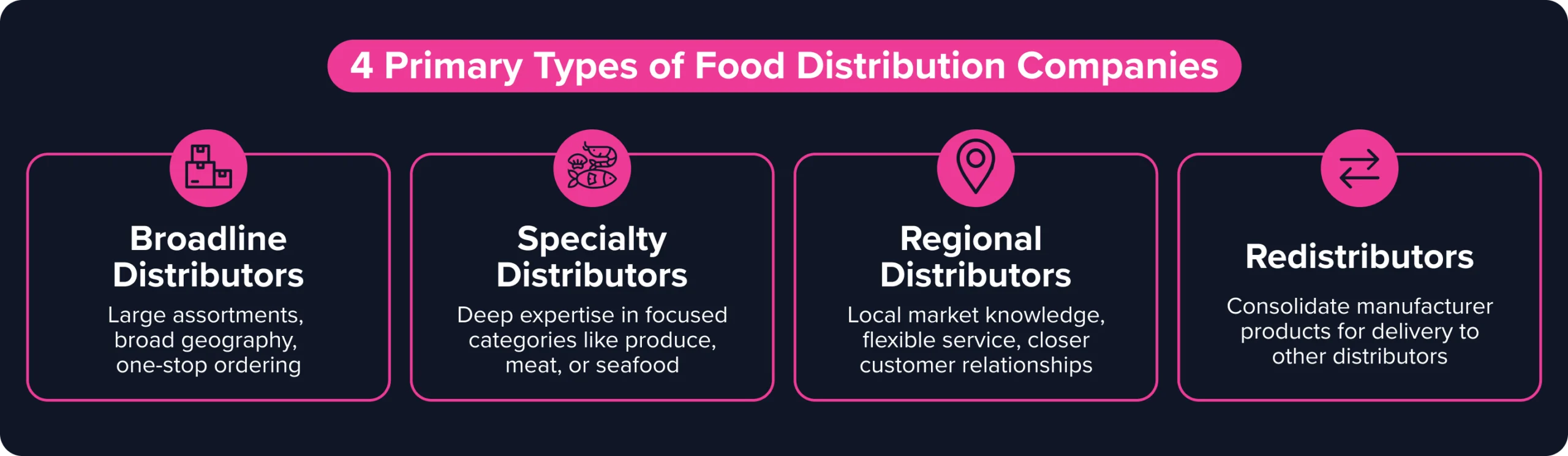
Food distribution is not a one-size-fits-all business. Some companies carry tens of thousands of products across large territories, while others build their reputations around a particular category, service model, or geographic market.
Understanding these differences matters because each distributor type brings its own strengths, cost structure, and customer relationships.
Broadline Distributors
Broadline distributors offer a large assortment of food, beverages, supplies, equipment, and other products through a single distribution network. Their customers may include independent restaurants, national chains, healthcare organizations, hospitality groups, schools, and institutional foodservice operations.
Their scale can provide several advantages:
- Wide product availability
- Extensive warehouse and transportation networks
- Consolidated ordering
- National or multi-regional coverage
- Access to private-label products
- Technology and customer-support resources
Broadliners must also manage enormous operational complexity. A large product catalog, multiple temperature zones, short shelf lives, and strict delivery windows leave little room for inaccurate forecasts or inefficient routes.
Specialty Food Distributors
Specialty distributors focus on a particular product category, cuisine, customer segment, or level of quality. Examples include produce, seafood, meat, bakery products, dairy, imported ingredients, and natural or organic foods.
These companies often compete through deep category knowledge and strong supplier relationships. A specialty distributor may be able to source hard-to-find products, provide detailed product guidance, or respond to quality requirements that fall outside a broadline distributor’s standard assortment.
That expertise can create customer loyalty, but it may also leave the business more exposed to volatility within a specific commodity or category.
Regional Food Distributors
Regional distributors serve customers within a defined geographic area. Their local market knowledge and proximity to customers can help them offer flexible service, faster response times, and relationships that feel more personal.
Many regional distributors compete by understanding the details of their markets: which restaurant concepts are expanding, what local operators need, and where larger distributors may not be providing the right assortment or service level.
Geographic concentration also creates risk. Weather events, regional economic conditions, labor availability, and changes in local customer traffic can have an outsized effect on performance.
Redistributors
Redistributors purchase products from manufacturers and consolidate them for delivery to other distributors. This allows manufacturers to serve a fragmented customer base without shipping smaller orders to numerous individual distribution centers.
For local and regional distributors, redistribution can provide access to a broader product assortment without requiring direct purchasing relationships or full truckload orders from every manufacturer.
Redistributors help connect the market, but they must balance freight efficiency, inventory availability, lead times, and product demand across multiple trading partners.
What Trends Are Shaping the Food Distribution Industry?
The fundamentals of distribution have not changed: purchase the right products, move them efficiently, and serve customers well. What has changed is the speed and precision now expected at every step.
The following trends are playing a major role in the current food distribution industry analysis and its longer-term outlook.
AI and Predictive Analytics
Artificial intelligence has quickly moved from a boardroom discussion to a practical operating tool. Distributors are exploring how AI and predictive analytics can support forecasting, inventory planning, pricing, sales prioritization, route management, and customer service.
For example, predictive models can help a distributor recognize when a customer’s purchasing pattern is beginning to change. A decline in a high-volume category, an unusual gap between orders, or a steady shift toward a competitor’s products may signal risk before the customer formally raises a concern.
The real value is not simply generating more information. It is helping teams decide where to act.
AI works best when it has clean, connected, and detailed data behind it. If customer names, product descriptions, units of measure, or transaction records are inconsistent, the output may be just as messy as the inputs.
Supply Chain Visibility and Traceability
Distributors are under increasing pressure to know where products are, where they came from, and where they are going.
Better visibility can help companies respond faster to:
- Recalls and food safety events
- Supplier disruptions
- Delivery delays
- Product shortages
- Temperature-control issues
- Changes in customer demand
Traceability has also become more important as regulatory requirements evolve. The FDA Food Traceability Rule establishes additional recordkeeping requirements for certain foods, making accurate data exchange across supply chain partners an even greater priority.
The companies best prepared for disruption are often the ones that can identify affected products, locations, customers, and alternatives without digging through disconnected systems.
Rising Transportation and Labor Costs
Transportation and labor remain two of the most stubborn expenses in food distribution.
Drivers, warehouse employees, selectors, buyers, sales representatives, and customer-service teams all play a role in getting products from the supplier to the operator. When labor is difficult to recruit or retain, overtime and training costs can rise while productivity and service consistency suffer.
Transportation brings another set of variables. Fuel prices, maintenance, insurance, vehicle availability, route density, and delivery frequency can quickly change the cost of serving an account.
That makes customer profitability more complicated than gross sales. A customer may generate meaningful revenue but require frequent small deliveries, extensive service, or an expensive route. Distributors need enough visibility to understand the full cost-to-serve equation.
Digital Procurement and Purchasing Platforms
Ordering is becoming increasingly digital. Operators expect purchasing tools to help them find approved products, compare options, track spending, and manage multiple locations without relying on emails, spreadsheets, or handwritten notes.
Digital procurement platforms can also create better visibility for distributors. When purchasing activity is connected across customers and locations, distributors can see demand patterns that would be difficult to uncover one order at a time.
That can help teams answer questions such as:
- Which products are gaining traction?
- Where is demand declining?
- Which customers are buying outside an expected assortment?
- What categories have the greatest expansion potential?
- Which substitutions are becoming permanent purchasing habits?
The benefit is not digitization for its own sake. It is having a clearer picture of what customers are buying and what they may need next.
Changing Restaurant Buying Behavior
Restaurant operators are taking a harder look at every purchasing decision. Food and labor costs remain high, guests are price sensitive, and many operators have limited room to raise menu prices without affecting traffic.
As a result, restaurant customers are asking more from their distributor relationships. They want competitive pricing, reliable fulfillment, flexible product options, useful data, and help identifying savings.
They may also split purchases among several suppliers to manage availability or compare costs. This can make wallet share more difficult to measure and customer loyalty harder to assume.
A distributor that waits for the next order may miss the larger shift taking place inside the account. Customer buying behavior must be viewed over time, across categories and locations.
What Challenges Are Food Distributors Facing?
Even in a growing market, distribution remains a tight-margin business. Small inefficiencies can multiply quickly when they are repeated across thousands of products, customers, invoices, and deliveries.
Margin Pressure and Price Competition
Distributors are caught between rising operating costs and customers looking for lower prices. Passing every increase downstream can strain the relationship, but absorbing those increases can steadily erode margin.
Price competition adds another layer. Operators may compare bids, shift categories between suppliers, or negotiate based on individual products without considering total service value.
Distributors need a detailed understanding of account and product profitability. That includes more than the invoice price. Freight, handling, rebates, spoilage, service requirements, and contract commitments all influence the actual return.
Inventory and Fleet Optimization
Too much inventory ties up capital and creates spoilage risk. Too little inventory leads to substitutions, missed sales, and unhappy customers.
The same balancing act applies to fleet management. Distributors must build routes that support service expectations without sending partially filled trucks across inefficient territories.
Strong optimization considers several connected factors:
- Product shelf life
- Warehouse capacity
- Order frequency
- Customer delivery windows
- Route density
- Vehicle utilization
- Seasonal demand
- Supplier lead times
When those decisions are managed separately, one team’s efficiency can become another team’s expense.
Demand Forecasting Accuracy
Foodservice demand can change quickly. Weather, holidays, sporting events, school calendars, local economic conditions, limited-time offers, and menu changes can all affect what customers order.
Historical averages provide a starting point, but they may not account for a customer opening new locations, changing its menu, switching suppliers, or losing traffic.
Forecasting becomes more reliable when distributors combine historical sales with current purchasing patterns and outside market signals. Even then, the goal is not a flawless prediction. It is making a better decision with enough time to act.
Customer Acquisition and Retention
Winning a new account can require months of sales activity, pricing work, product matching, and onboarding. Losing that account may happen one category at a time.
A customer may continue ordering while gradually moving meat, produce, disposables, or beverages to another supplier. By the time the overall sales decline is obvious, the distributor may already be defending a much smaller piece of the business.
Retention requires early visibility into those changes. Sales teams need to know where purchasing is slipping, where service issues are occurring, and where a customer could benefit from a different product or program.
How Can Food Distributors Improve Business Performance?
The next phase of growth will not come only from moving more cases. Distributors also need to understand where demand exists, which opportunities are worth pursuing, and how customer behavior is changing.
That is where transaction-level purchasing intelligence can make a measurable difference.
Using Purchasing Data to Understand Customer Demand
Distributors have plenty of sales data. The missing piece is often what their customers are buying elsewhere.
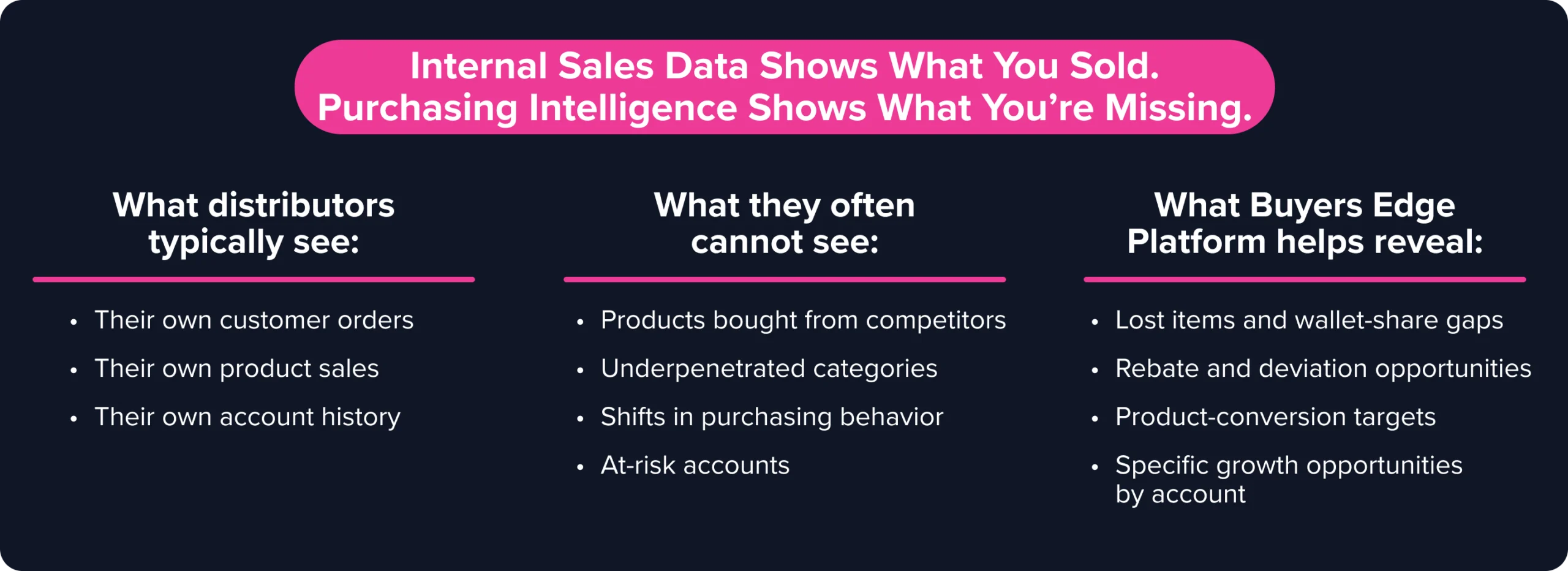
A distributor’s internal systems typically show only the products it sells to an operator. They do not reveal the cases going to competitors, the categories where market share is slipping, or the products an account may be purchasing outside its primary agreement.
Buyers Edge Platform helps close that gap. We collect, clean, and organize purchasing data across more than 100,000 foodservice operators and 1,000 distributors. Through our Distributor Partner Portal, distributor partners can see where they are winning business, where they may be losing it, and which categories offer room to grow.
That visibility can help teams:
- Identify products customers are buying from competitors
- Understand purchasing patterns at the account and location level
- Monitor rebates, savings, and product conversions
- Find gaps in category penetration
- Spot changes that could signal an at-risk account
- Make smarter decisions about what to stock and sell
It is essentially dumpster diving for the digital age, minus the actual dumpster. Instead of searching for a competitor’s invoice, distributors can use purchasing intelligence to understand what is happening inside their accounts.
Identifying Competitive Growth Opportunities
For most distributors, the goal is straightforward: win new business and grow cases. The difficult part is knowing where to focus.
Not every sales opportunity carries the same potential. One account may offer room to add a handful of products, while another is purchasing entire categories from a competitor. Without visibility into that activity, both opportunities may look the same to a sales representative.
Buyers Edge Platform’s distributor technology helps sales teams work their accounts with greater precision. The platform can identify top items lost to competitors, highlight underpenetrated categories, and provide price and product guidance that supports more competitive offers.
Distributor sales representatives can use these insights to prioritize:
- Products and categories being purchased from competitors
- Accounts with significant untapped wallet share
- Targeted product-conversion opportunities
- Customers whose purchasing activity is beginning to decline
- Products with available rebates or deviations
- Categories showing demand across similar operators
This gives DSRs a stronger reason to start the conversation. Instead of asking a customer what else they could sell them, the representative can arrive with a specific opportunity based on what that customer is already buying.
Optimizing Pricing and Contract Strategies
Competitive pricing matters, but lowering a price without understanding the account can trade sales growth for margin loss.
Distributors need to consider the product cost, expected volume, customer relationship, competitive offer, service requirements, and potential value of the entire account. They also need enough flexibility to structure contracts in a way that supports their goals and their customers’ profitability.
Buyers Edge Platform gives distributor partners access to customizable contracts, rebates, and deviations that can support more strategic bids. Price and product guidance can also help sales teams determine where a more competitive offer could win business without treating every account or opportunity the same way.
The platform provides client- and location-level visibility into rebates, savings, and targeted product conversions, helping teams evaluate questions such as:
- Are customers purchasing the products covered by their agreements?
- Which lost products may be realistic to win back?
- Where could a rebate or deviation strengthen an offer?
- Are product conversions producing the intended results?
- Which accounts are generating greater sales but weaker profitability?
- Where could an alternative product create value for both parties?
This information supports pricing conversations grounded in actual purchasing behavior, rather than a race to offer the lowest number.
Building Stronger Customer Relationships
Technology can identify an opportunity, but relationships determine what happens next.
The most useful insights help sales representatives have better conversations. A DSR may point out a product the customer could purchase at a more competitive price, recommend a rebated alternative, help prepare for seasonal demand, or identify a category currently going to another distributor.
Buyers Edge Platform also helps distributor partners bring value to customers beyond food and supplies. Through hundreds of indirect-spend discount programs, distributors can help operators save on services such as uniforms, television subscriptions, pest control, and other operating expenses.
These added benefits give distributors another way to reward and retain important accounts. They can become a resource for the customer’s broader business, not simply the company making the next delivery.
Buyers Edge Platform supports that relationship with:
- A Distributor Partner Portal containing purchasing insights, performance metrics, and sales-penetration opportunities
- Client-level details on rebates, savings, and targeted conversions
- Contracts and programs tailored to the distributor’s goals
- Training that helps sales and business-development teams use the available insights
- Support for sales meetings, sales blitzes, marketing initiatives, and public relations campaigns
In a highly commoditized industry, value beyond the case can become a meaningful competitive advantage.
Conclusion
Food distribution is a large, essential, and highly competitive industry. It also operates under pressure from nearly every direction: uncertain demand, rising costs, tight margins, complicated logistics, changing customer expectations, and an enormous amount of data that is not always easy to use.
The market outlook is not simply about whether industry revenue will grow. It is about which distributors can turn that growth into profitable new business, larger drops, and stronger customer relationships.
This food distribution industry analysis points to a clear opportunity. Distributors need visibility beyond their own invoices. Understanding what customers buy from competitors can help teams find lost cases, identify underpenetrated categories, build more competitive offers, and reach accounts before purchasing behavior becomes a retention problem.
Buyers Edge Platform gives distributor partners unprecedented insight into restaurant purchasing activity. Our technology reveals where a distributor is winning, where business is going elsewhere, and which products and categories offer the strongest opportunity to grow cases.
It is information sales teams can act on, supported by price guidance, product intelligence, customizable programs, rebates, deviations, training, and marketing resources.
New business. New cases. Unprecedented insights.
Ready to see where your next sales opportunity may be hiding? Click here to contact Buyers Edge Platform to learn how our distributor technology can help your team sell more effectively, penetrate additional market share, and deliver more value to every account.
FAQs
What is the projected growth of the food distribution market?
The market is expected to continue growing alongside food-away-from-home spending, although growth will vary by segment and may reflect both inflation and changes in case volume. Because research firms define the market differently, forecasts should be evaluated based on geography, customer segment, and whether they measure foodservice distribution or the broader food wholesale industry.
What are the biggest trends in food distribution?
Major trends include AI-supported forecasting, greater supply chain visibility, enhanced product traceability, digital procurement, and increased use of customer purchasing data. Distributors are also investing in automation and analytics to control costs and improve service.
What challenges do food distributors face?
Food distributors face margin pressure, price competition, labor and transportation costs, inventory complexity, uncertain demand, and customer-retention challenges. Many must improve efficiency while maintaining dependable service and competitive pricing.
How is technology transforming food distribution?
Technology is helping distributors forecast demand, optimize inventory and routes, automate routine processes, monitor customer purchasing patterns, and identify sales opportunities. Digital platforms also make it easier to connect information across suppliers, distributors, and foodservice operators.
How can distributors improve profitability?
Distributors can improve profitability by understanding cost to serve, reducing inventory and transportation inefficiencies, strengthening pricing controls, and finding additional opportunities within existing customer accounts. Better purchasing data can help teams focus on the customers, products, and categories with the greatest potential.