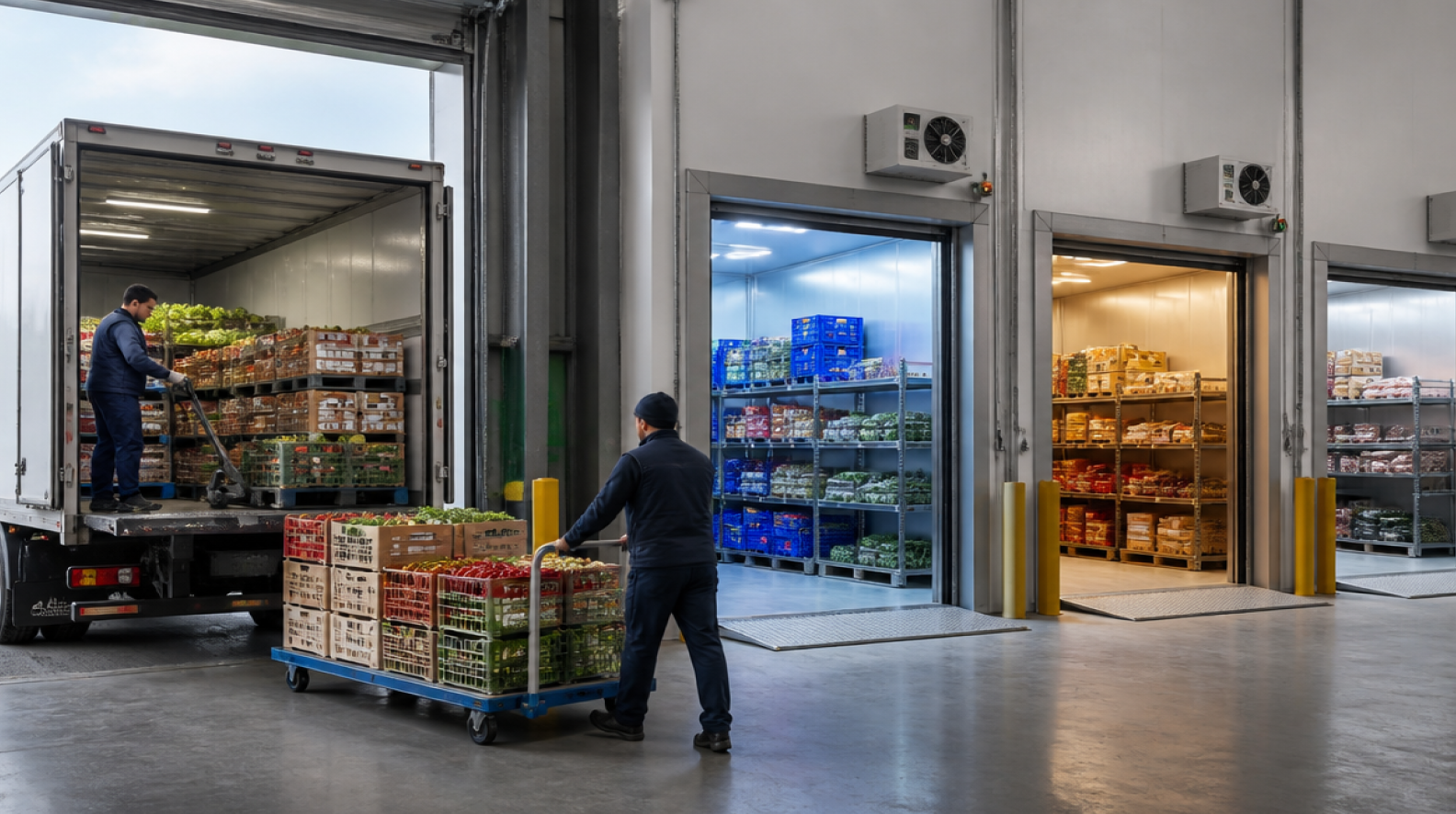
If you’ve ever wondered why some food and beverage brands seem to be everywhere (stocked in every walk-in cooler, featured on regional menus, and reliably delivered by broadline trucks), the answer almost always comes down to one thing: restaurant distribution.
For manufacturers, getting a product onto a restaurant menu takes more than a great recipe, strong branding, or competitive pricing. It takes a clear, strategic approach to the invisible machinery that moves goods from a factory floor to a commercial kitchen.
In this guide, we break down how restaurant distribution works, the models that dominate the space, the common hurdles you will encounter, and the data-driven strategies you can use to grow your market share.
What Is Restaurant Distribution?
Restaurant distribution refers to the specialized supply chain network and process used to move food products, beverages, equipment, and non-food supplies from manufacturers to foodservice operators.
Because restaurants purchase hundreds of ingredients and disposables every week, they cannot manage individual shipments from hundreds of independent producers. Restaurant distribution serves as the critical commercial link between CPG or foodservice manufacturers and end operators, including independent restaurants, multi-unit chains, hospitality groups, schools, and healthcare facilities.
Distributors purchase products from manufacturers in bulk, store them across regional warehouse networks, and deliver consolidated truckloads directly to restaurant back doors on tight schedules. When it works well, manufacturers gain broader market access, distributors move product efficiently, and restaurants get the ingredients they need to serve customers consistently.
How Does Restaurant Distribution Work?
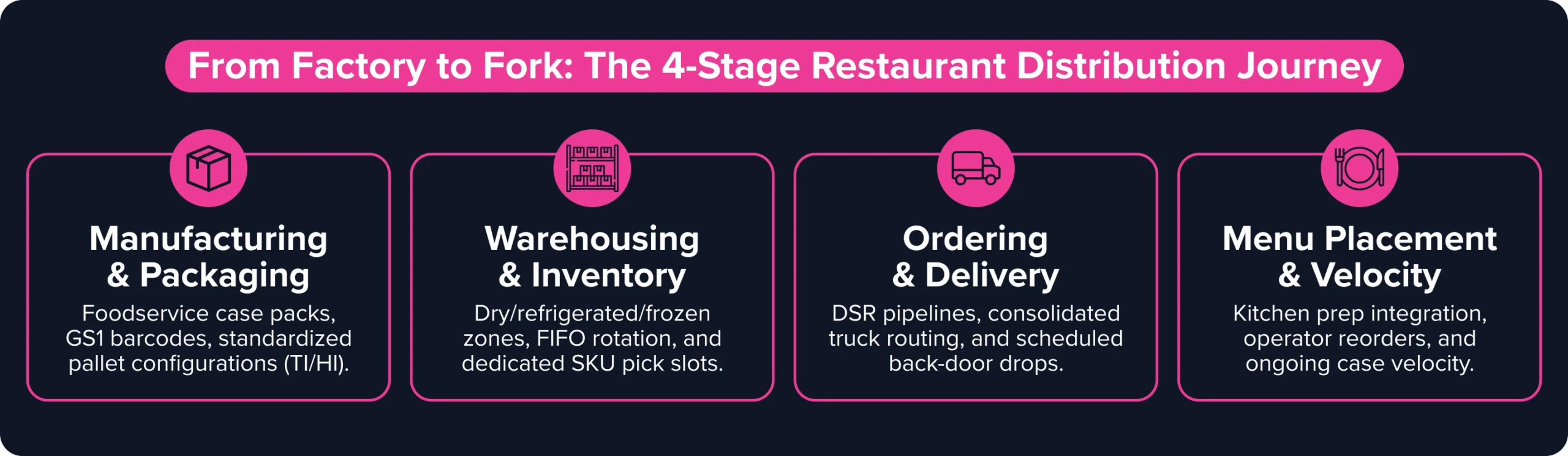
The journey from a production facility to a restaurant kitchen involves several handoffs. To optimize sales velocity, manufacturers must understand how their items move through each stage of the restaurant distribution cycle.
Manufacturing Products for Distribution
The process starts with production and packaging built specifically for commercial use. Unlike retail goods designed for grocery shelves, products destined for restaurant distribution require foodservice-ready case packs, durable corrugated packaging, standardized pallet configurations (TI/HI), and GS1 barcoding. Products must withstand ambient, refrigerated, or frozen freight handling while matching the portion-control and prep needs of commercial kitchens.
Warehousing and Inventory Management
Once produced, goods move via full truckload (FTL) or less-than-truckload (LTL) freight to distributor warehouses. Modern foodservice distributors operate multi-temperature distribution centers (DCs) featuring dry, refrigerated, and frozen storage zones. Here, distributors manage inventory turns, monitor expiration dates via first-in, first-out (FIFO) rotations, and allocate dedicated pick slots for every authorized stock-keeping unit (SKU). For manufacturers, maintaining communication around lead times, production schedules, and promotional activity is essential to prevent stockouts or unnecessary carrying costs.
Restaurant Ordering and Delivery
Restaurants place orders with their approved distributors, often through online ordering systems, sales representatives, or account managers. The distributor then picks, loads, and delivers those products based on established routes and delivery schedules. This is one of the most visible parts of restaurant distribution because it affects day-to-day kitchen prep directly. If deliveries are late, incomplete, or inconsistent, operators feel the impact immediately.
Product Placement on Restaurant Menus
Receiving the product is the final operational step, but menu integration is where true volume occurs. A product only succeeds when a restaurant operator buys it, uses it, and keeps ordering it because it performs well in the kitchen. That means restaurant distribution is tied closely to sales support and operator demand. Real distribution success happens when products move consistently from warehouse shelves into restaurant recipes, limited-time offers, or permanent menu placements.
What Types of Restaurant Distribution Models Exist?
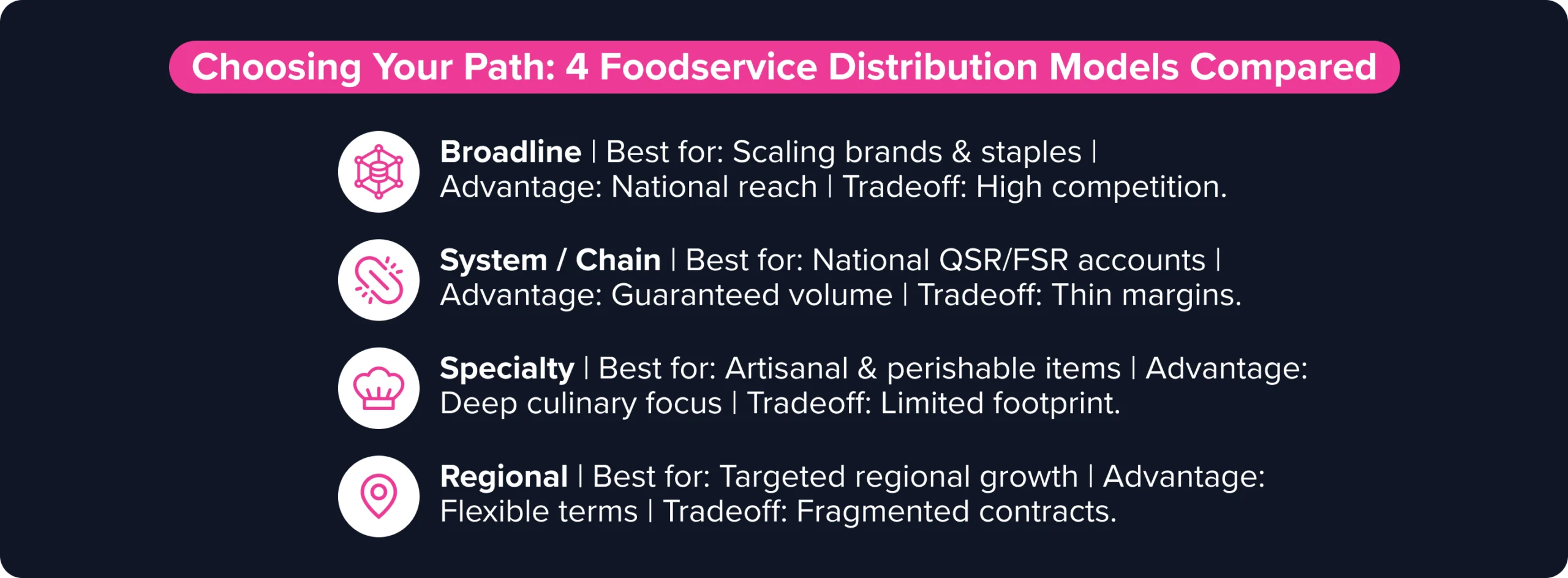
Not all restaurant distribution works the same way. Different distributor models serve different types of operators, product categories, and geographies. Manufacturers need to understand these models so they can choose the right path for growth.
| Distribution Model | Definition & Focus | Typical Players / Examples | Best For | Key Advantages & Tradeoffs |
|
Broadline Distributors |
Massive distributors carrying thousands of SKUs across every food, paper, and chemical category. | Sysco, US Foods, Performance Food Group (PFG) | Scaling brands, multi-unit concepts, high-volume staple ingredients | Pros: Massive national reach, single-drop consolidation. Cons: High competition for DSR attention, strict slotting/fee requirements. |
|
System (Chain) Distributors |
Specialized logistics providers handling dedicated supply chains for large national restaurant chains. | McLane Foodservice, Martin-Brower, HAVI | Established brands contracted by national QSR/FSR chains | Pros: Guaranteed high volume, predictable demand curves. Cons: Razor-thin margins, strictly driven by corporate mandate. |
|
Specialty Distributors |
Niche distributors focused on specific categories (e.g., local produce, craft proteins, gourmet imports). | Chefs’ Warehouse, Baldor Specialty Foods, regional seafood houses | Artisanal, premium, organic, or perishable boutique items | Pros: Deep culinary expertise, high chef engagement. Cons: Limited geographic reach, lower total case volume. |
|
Regional Distributors |
Independent distributors serving localized territories or regional markets. | UniPro members, Shamrock Foods, Gordon Food Service (GFS) | Brands looking for focused regional growth and personal relationships | Pros: Accessible buyer access, flexible merchandising terms. Cons: Fragmented footprint requires managing multiple regional contracts. |
In practice, many manufacturers use more than one restaurant distribution model at the same time to balance volume, reach, and specialized category support.
How Do Manufacturers Get Products Into Distribution?
Getting into a distributor’s catalog takes more than just presenting a product sheet and hoping for a yes. Food distributors protect their warehouse real estate aggressively; they will not stock an item without clear proof that it will move quickly.
Secure Distributor Authorization
The first step is securing authorization (often called getting “slotted”) from the distributor. Manufacturers must present a strong business case to category managers, including competitive pricing, consumer demand trends, margin potential, and marketing support. Manufacturers often pay slotting fees or agree to initial guaranteed buy-backs to offset the distributor’s inventory risk.
Build Distributor Sales Representative Support
Getting listed is only the beginning. One of the most important steps in restaurant distribution is earning support from Distributor Sales Representatives (DSRs). DSRs influence what operators see, sample, and order. Manufacturers can support this by providing training, product education, menu application ideas, sales materials, and targeted sales incentives (spiffs) to keep products top-of-mind.
Create Operator Demand
Distributors are much more likely to support products that operators are already requesting. When influential local chefs, regional multi-unit operators, or group purchasing organizations (GPOs) demand an item by name, the distributor is compelled to stock it. Manufacturers drive this demand through field sampling, culinary trade shows, digital marketing, and direct engagement with decision-makers.
Meeting Distributor Requirements
Every distributor has operational and commercial requirements that manufacturers must meet:
- Full Electronic Data Interchange (EDI) compliance for purchase orders, shipping notices, and invoicing.
- Strict adherence to shelf-life minimums and food safety certifications (such as SQF, BRCGS, or HACCP).
- On-time, in-full (OTIF) delivery expectations and precise case-pack labeling.
What Challenges Affect Restaurant Distribution?
Even well-designed restaurant distribution programs face friction. Market conditions, operational constraints, and demand shifts can all affect how products move through the channel.
Inventory Availability and Fill Rates
If inventory is not available when restaurants place orders, distribution performance suffers quickly. Foodservice operators cannot afford stockouts during a busy rush. Maintaining a 98%+ order fill rate is critical; otherwise, distributors will substitute competing brands or drop the SKU altogether.
Transportation and Logistics Costs
Freight, fuel, routing, labor, and cold chain requirements all affect the cost side of restaurant distribution. Managing LTL freight costs while maintaining reliable delivery schedules requires active logistics planning and regional warehouse positioning.
Demand Forecasting and Planning
Forecasting is one of the hardest parts of restaurant distribution. Demand can shift due to seasonality, menu changes, promotions, or viral trends. Static forecasts fail; manufacturers that work closely with distributors to share forecasts and promotional calendars are better positioned to keep supply aligned with demand.
Distributor Performance Management
Restaurant distribution is not static. A manufacturer may have good placement on paper but inconsistent execution in the field. Tracking order frequency, fill rates, branch activity, and customer penetration helps reveal where support needs to improve.
How Can Manufacturers Improve Distribution Performance?
Improving restaurant distribution requires ongoing attention and a shift from passive placement to active, data-led channel management.
Expanding Distribution Coverage
Growth often starts with broader, strategic coverage. Rather than attempting a nationwide broadline rollout all at once, leading manufacturers identify high-density markets, establish regional beachheads with specialty and independent distributors, and leverage GPO network relationships.
Strengthening Distributor Partnerships
Strong relationships still matter. Manufacturers that communicate clearly, support sales teams, respond quickly to issues, and bring useful market insight are generally better partners. Coordinating regular business reviews (QBRs) and co-funding operator promotions help align commercial goals.
Measuring Distribution Success
Manufacturers should define what success looks like and track granular KPIs:
- Case Velocity per DC: How many cases are turning per warehouse slot each month?
- Drop-Size Average: Are operators ordering single emergency cases or full production batches?
- Fill Rate and On-Time Delivery %: Are logistics partners meeting baseline distributor thresholds?
- Rebate & Billback Accuracy: Are contract pricing concessions matching verified end-operator purchases?
How Does the Buyers Edge Help Manufacturers Improve Distribution Performance?
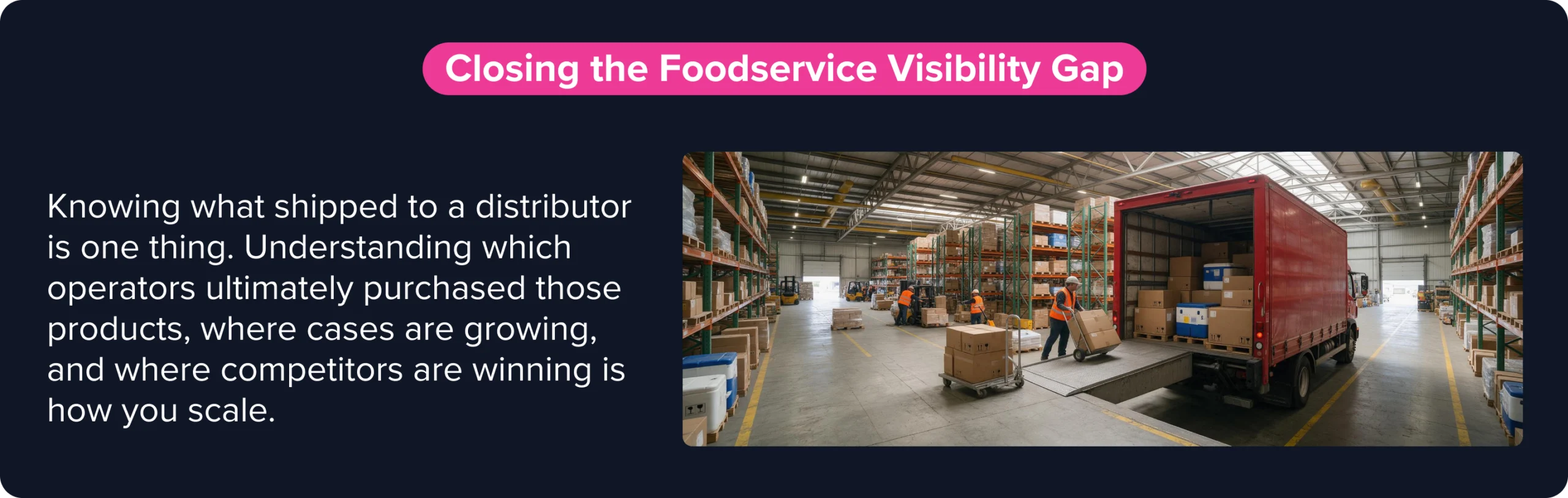
For many manufacturers, visibility becomes limited once product enters the distributor network. Knowing what shipped to a distributor is one thing. Understanding which operators ultimately purchased those products, where cases are growing or declining, and where competitive products are winning is another.
Buyers Edge Platform helps close that visibility gap by combining operator purchasing data, manufacturer technology, and sales and marketing support to give manufacturers a clearer view of product performance across the foodservice channel.
Buyers Edge Platform’s AI-driven manufacturer portal, partners can turn purchasing data into actionable sales opportunities, including:
- See Where Products Are Winning: Track volume, cases, locations, and growth to better understand where products are gaining traction across the Buyers Edge Platform operator network and direct contract business.
- Identify Competitive Opportunities: See where operators are purchasing comparable products from competitors, helping sales teams identify opportunities to win new cases and expand share of wallet.
- Track New Operator Adoption: Identify locations purchasing a product for the first time, drill into product and volume details, and give sales teams clearer opportunities to grow those accounts.
- Spot and Recover Lost Business: See when locations that previously purchased a product stop buying, allowing teams to respond sooner and pursue opportunities to win those cases back.
- Target Growth More Precisely: Use regional and operator-level insights to uncover sales voids and focus sales and marketing efforts on the operators and markets with the strongest potential.
Data alone doesn’t move cases. Buyers Edge Platform pairs these insights with dedicated manufacturer growth, sales, and marketing support to help partners turn opportunities into action through targeted campaigns and operator engagement.
For manufacturers working to improve restaurant distribution, that means moving beyond simply asking, “Where is my product distributed?” and gaining the insight to answer a much more valuable question: “Where can we grow next?”
FAQs
How does restaurant distribution work?
Restaurant distribution works by moving products from manufacturers through distributors and then on to restaurant operators. Manufacturers produce and package items for foodservice, distributors warehouse and manage inventory, and restaurants place orders through approved channels for scheduled delivery. The goal is to make products consistently available to operators so they can use them on menus without disruption.
What is the difference between a food distributor and a food broker?
A food distributor takes physical ownership of goods, warehouses inventory, coordinates delivery logistics, and bills the restaurant directly. A food broker acts as an independent sales agent who represents the manufacturer to pitch products to distributors, retailers, or operators and build demand; brokers earn a commission on sales but never hold inventory or deliver products.
Who are the largest restaurant food distributors?
The largest broadline restaurant distribution companies in North America include Sysco, US Foods, and Performance Food Group (PFG), alongside specialized supply chain operators like McLane Foodservice, Martin-Brower, and Gordon Food Service (GFS).
What is the difference between broadline and specialty distribution?
Broadline distribution offers a wide range of products across many foodservice categories, allowing restaurants to consolidate purchases with one main supplier. Specialty distribution focuses on narrower categories such as meat, seafood, produce, bakery, desserts, or international items, offering deep category expertise and a more targeted sales approach.
Can manufacturers sell directly to restaurants?
Yes, manufacturers can sell directly to restaurants in some cases, especially to local independents, small groups, or via Direct-Store-Delivery (DSD). However, direct sales can be difficult to scale because they require managing fulfillment, delivery, customer service, and account management. That is why many brands rely on restaurant distribution partners to reach more operators efficiently and support ongoing reorder behavior.