
What if the difference between a product that stalls on shelves and one that scales nationally comes down to choosing the right food broker?
Getting a product into the foodservice market takes more than making something operators want to buy. Manufacturers also have to figure out how that product will be sold, who will help get it in front of the right buyers, and how it will ultimately make its way to the operator.
That’s where the different players in the foodservice supply chain come in.
Food brokers, distributors, group purchasing organizations (GPOs), manufacturers and operators can all be part of the process, but they play very different roles. Understanding those differences matters, especially for manufacturers deciding where to invest their sales resources and how to reach more of the market.
A food broker is one option. Brokers have traditionally helped manufacturers build relationships and generate sales within specific markets. But they aren’t the only route available, and the right approach often depends on what a manufacturer is trying to accomplish.
Here’s a closer look at what food brokers do, how they compare with other parts of the foodservice supply chain, and where additional growth opportunities may exist.
What Is a Food Broker?
A food broker is an independent sales representative or agency that typically represents food and beverage manufacturers within a particular market, territory or category.
Rather than building an internal sales team to cover every market, a manufacturer may work with a broker that already has relationships with distributors, operators and other foodservice buyers.
The broker generally acts as a sales connection between the manufacturer and prospective customers. Depending on the arrangement, that can include introducing products, supporting sales presentations, helping with promotions and providing information about what’s happening within the market.
One important distinction: a food broker typically does not purchase, warehouse or physically deliver the manufacturer’s products.
That’s generally the distributor’s job.
What Role Does a Food Broker Play for Manufacturers?
The exact responsibilities of a food broker vary. A national manufacturer may use brokers differently than a smaller manufacturer trying to enter a new region, for example.
Still, there are several areas where brokers commonly support manufacturers.
Connect Manufacturers with Distributors and Operators
Relationships are a big part of foodservice sales.
An established broker may already know the distributors, restaurant groups, hospitality companies, healthcare organizations or other operators within a particular market. Those existing relationships can give a manufacturer a way into conversations that may otherwise take considerable time to develop.
For a manufacturer entering a new geography or foodservice segment, that local knowledge can be especially useful.
The broker can introduce the product, help communicate its value, and serve as a point of contact throughout the sales process.
Provide Market Intelligence and Competitive Insights
Selling into foodservice requires knowing more than who’s buying.
Manufacturers need to understand what’s happening within the market. What products are operators asking for? Which categories are growing? What challenges are buyers talking about? Where is the competition gaining ground?
Because brokers are regularly talking with distributors and operators, they can provide manufacturers with feedback from the field.
That information may help a manufacturer adjust its sales approach, refine product positioning, or identify opportunities that weren’t initially on the radar.
Support Sales Growth and Promotional Programs
Food brokers may also help manufacturers execute sales and promotional programs within their assigned markets.
That could mean introducing a new product, presenting samples, supporting distributor sales meetings, or helping communicate a manufacturer promotion to prospective customers.
The manufacturer still owns the larger brand and sales strategy. The broker helps carry that strategy into the market and turn it into conversations with buyers.
Manage Administrative and Compliance Activities
Foodservice sales come with plenty of behind-the-scenes work, too.
Depending on the relationship, brokers may assist with certain administrative responsibilities tied to the accounts they support. That can include maintaining product information, coordinating paperwork, helping communicate pricing or program details, and keeping manufacturers informed about activity within the territory.
The scope can vary significantly from one brokerage agreement to another, so manufacturers should be clear about which responsibilities sit with the broker and which remain internal.
Food Broker vs. Distributor vs. GPO
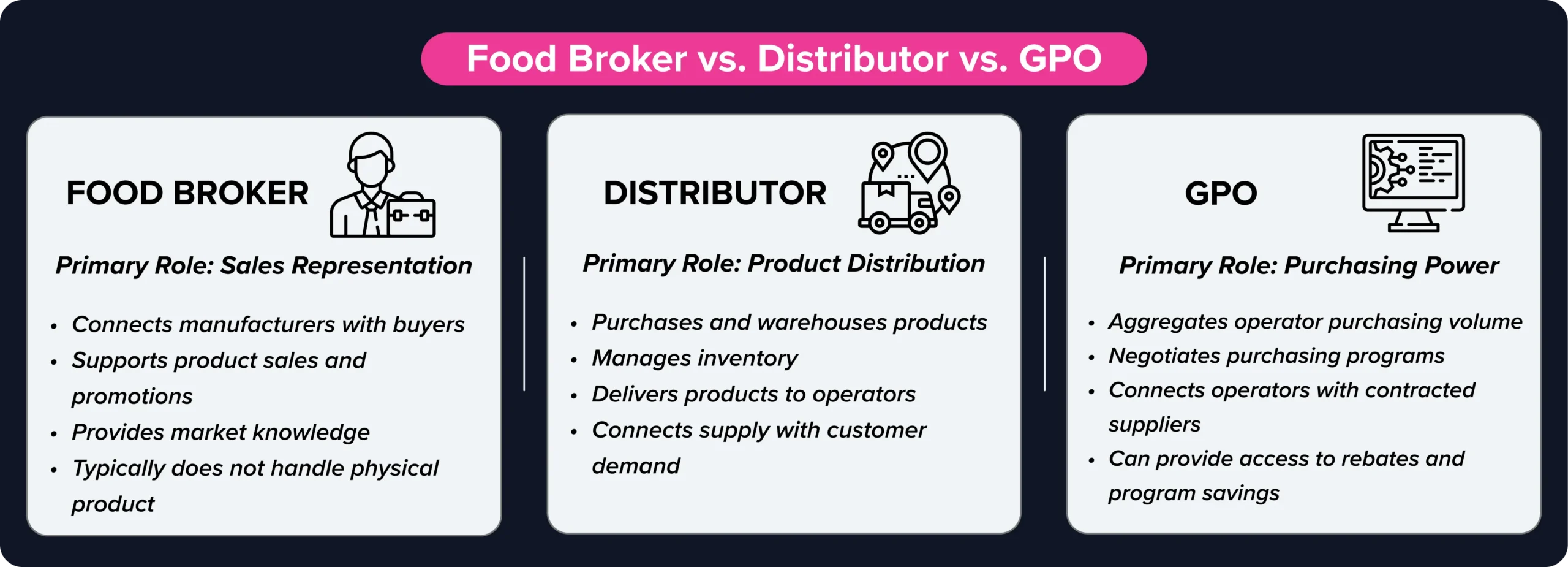
Food brokers, distributors and GPOs all connect manufacturers with the foodservice market in some way, which makes it easy to lump them together. Their actual functions are quite different.
| Food Broker | Distributor | GPO | |
|
Primary role |
Represents manufacturers and supports sales | Purchases, warehouses and delivers products | Aggregates purchasing volume and negotiates programs |
|
Typically works with |
Manufacturers, distributors and operators | Manufacturers and foodservice operators | Operators, manufacturers and distributors |
| Handles physical product? | Typically no | Yes | No |
|
Ownes inventory? |
Typically no | Often yes | No |
|
Primary value to manufacturers |
Sales representation and market relationships | Product distribution and access to customers | Access to aggregated operator purchasing demand and contracted programs |
|
Primary value to operators |
Product education and manufacturer connection | Product availability and delivery | Purchasing programs, negotiated value and potential rebates |
These organizations aren’t necessarily competing with one another. In many cases, they work within the same foodservice ecosystem.
A manufacturer could use a broker to help generate demand, sell through a distributor that physically moves the product and participate in a GPO program that connects the manufacturer with participating operators.
What Types of Food Brokers Are Available?
There isn’t one standard brokerage model that fits every manufacturer.
Food brokers can specialize by market, geography, customer type or product category. Understanding those differences can help manufacturers determine what kind of representation makes sense for their goals.
Retail vs. Foodservice Brokers
While retail and foodservice may involve many of the same products, selling into those markets is different.
Retail brokers typically focus on grocery stores, convenience stores and other consumer-facing retailers. Their work may involve shelf placement, retailer relationships, merchandising and consumer promotions.
Foodservice brokers focus on customers such as restaurants, hotels, healthcare facilities, schools, universities and other operations serving food away from home.
Manufacturers that sell into both markets may use different sales partners for each because the buyers, distribution networks and purchasing processes can differ considerably.
National, Regional, and Boutique Brokers
Brokerages also vary by geographic reach and size.
National brokers may provide representation across multiple markets, giving manufacturers broader coverage through a single organization.
Regional brokers concentrate on a particular part of the country and may bring strong relationships and knowledge within those markets.
Boutique brokers tend to be smaller and may offer highly specialized representation or a more hands-on approach with a limited number of manufacturers.
Bigger isn’t automatically better, and neither is smaller. The right fit depends on where the manufacturer needs coverage and what it expects from the relationship.
Category and Specialty Brokers
Some brokers focus on specific product categories or areas of foodservice.
A specialty broker, for example, may concentrate on produce, seafood, beverages, specialty ingredients or another defined category. Others may specialize in serving particular segments, such as healthcare or hospitality.
That specialization can be valuable when a product requires deeper category knowledge or when the manufacturer is trying to reach a very specific type of buyer.
What Are the Benefits and Limitations of Working with a Food Broker?
Food brokers have been part of the foodservice sales model for a long time for a reason. They can give manufacturers relationships and market coverage without requiring them to build a large sales organization from scratch.
At the same time, brokerage isn’t the only way to grow foodservice sales.
Understanding both sides can help manufacturers decide where brokers fit within a larger go-to-market strategy.
Benefits for Foodservice Manufacturers
For manufacturers, one of the biggest potential advantages is market access.
A broker may already have relationships that would take an internal sales team months or years to build. That can make it easier to enter a new territory, reach additional distributors or get products in front of operators.
Brokers can also provide local knowledge. A manufacturer doesn’t necessarily need an employee in every market when it can rely on a representative who already understands the area.
Other potential benefits include additional sales coverage, product representation, customer feedback and support for promotions or new product introductions.
For manufacturers with limited internal sales resources, those capabilities can extend the team’s reach.
Common Limitations of Traditional Brokerage
The brokerage model also has practical limitations manufacturers should consider.
Coverage is one.
A broker can only reach the accounts, territories and relationships within its network. If a manufacturer wants to expand well beyond that footprint, it may need multiple brokerage relationships or additional sales channels.
Visibility can be another challenge. Manufacturers increasingly want to understand what’s happening after a product enters the market: who’s buying, where volume is moving and where there may be untapped demand.
Traditional relationship-based selling doesn’t always provide that level of data on its own.
There’s also the question of focus. Brokers often represent multiple manufacturers, which means a brand is generally one of several competing for time and attention.
None of these issues mean brokerage doesn’t work. They simply make it important for manufacturers to consider brokerage as one part of a broader foodservice sales strategy rather than assuming it has to be the entire strategy.
How Much Does a Food Broker Cost?
There isn’t a single standard fee for working with a food broker.
Compensation structures vary based on the broker, product category, market, services provided and the manufacturer’s agreement.
Many brokers are compensated through commissions based on sales, while other arrangements may involve retainers, fees or a combination of compensation models. There may also be different terms depending on whether the broker is handling an established territory or helping a manufacturer develop new business.
Manufacturers evaluating a broker should look beyond the percentage or fee alone.
The bigger question is what they’re receiving in return. Territory coverage, account access, sales support, reporting, category expertise and the broker’s existing relationships can all affect the value of the partnership.
Before signing an agreement, manufacturers should understand exactly what services are included, how compensation is calculated and how performance will be evaluated.
How Can Manufacturers Expand Beyond Traditional Brokerage?
For manufacturers already working with brokers, expanding beyond traditional brokerage doesn’t necessarily mean replacing those relationships.
It can mean adding other ways to reach the market.
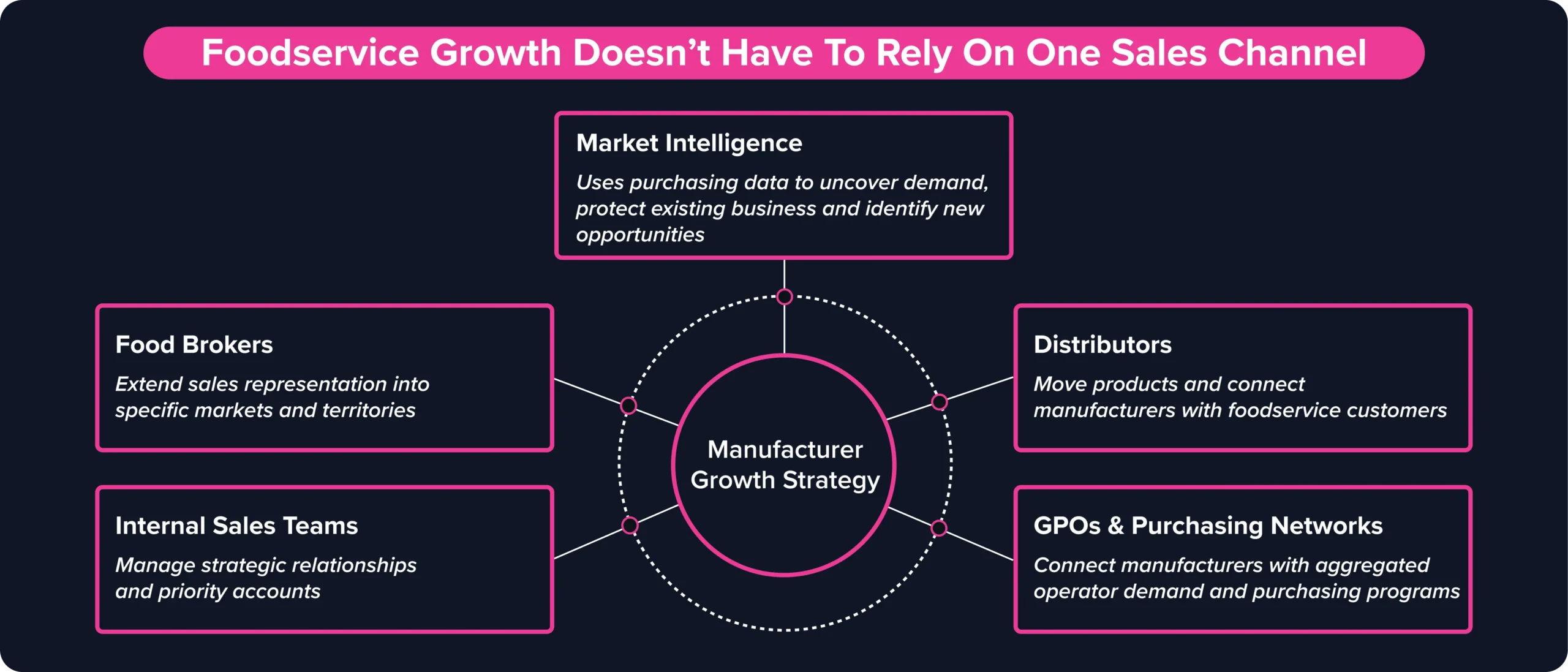
Foodservice purchasing has become increasingly connected to data, technology and large networks of operator demand. That gives manufacturers more ways to understand where their products are being purchased and where additional opportunities may exist.
New Sales Opportunities Through Purchasing Data
Purchasing data can tell manufacturers something a list of prospective accounts can’t: where actual buying activity is happening.
That distinction matters.
Instead of relying only on cold outreach or existing relationships, manufacturers can use purchasing insights to better understand demand across operators, markets and categories.
That can help sales teams prioritize their efforts.
For example, purchasing behavior may reveal markets where a category is performing well but a particular manufacturer has limited penetration. It may also show where operators are purchasing comparable products, creating a potential opportunity for the manufacturer to earn new business.
The goal isn’t data for the sake of data. It’s knowing where the sales team has a reason to start a conversation.
Market Expansion Beyond Existing Accounts
Growth becomes harder when a manufacturer keeps selling to the same pool of customers.
Broker relationships may provide strong coverage within certain territories or account networks, but manufacturers may still have large portions of the foodservice market they aren’t reaching.
Expanding into new operator segments, geographies or purchasing networks can create another path to growth.
A manufacturer that primarily sells into restaurants, for example, may find opportunities within hospitality, senior living, education or other foodservice segments. The product hasn’t changed. The potential customer base has.
The challenge is identifying those opportunities and finding an efficient way to reach them.
Building a Multi-Channel Sales Strategy
For many manufacturers, the answer isn’t choosing between a broker and another sales channel.
It’s using several.
A manufacturer may have an internal sales team handling strategic accounts, brokers supporting specific markets, distributor relationships moving products and GPO programs connecting the brand with additional operators.
Each serves a different purpose.
A multi-channel strategy can give manufacturers broader market coverage while reducing dependence on any single route to the customer.
The important part is understanding how those channels work together and where gaps still exist.
How Does the Buyers Edge Help Manufacturers Grow Foodservice Sales?
Relationships will always matter in foodservice sales. But relationships alone don’t necessarily tell a manufacturer what’s happening once products move through distribution.
That’s where better visibility can make a difference.
Buyers Edge Platform helps manufacturers gain that visibility with tools like SalesStream, a market intelligence solution from ArrowStream. SalesStream gives foodservice manufacturers access to operator and distributor market data that can help them understand true sell-through, protect existing business and find new opportunities for growth.
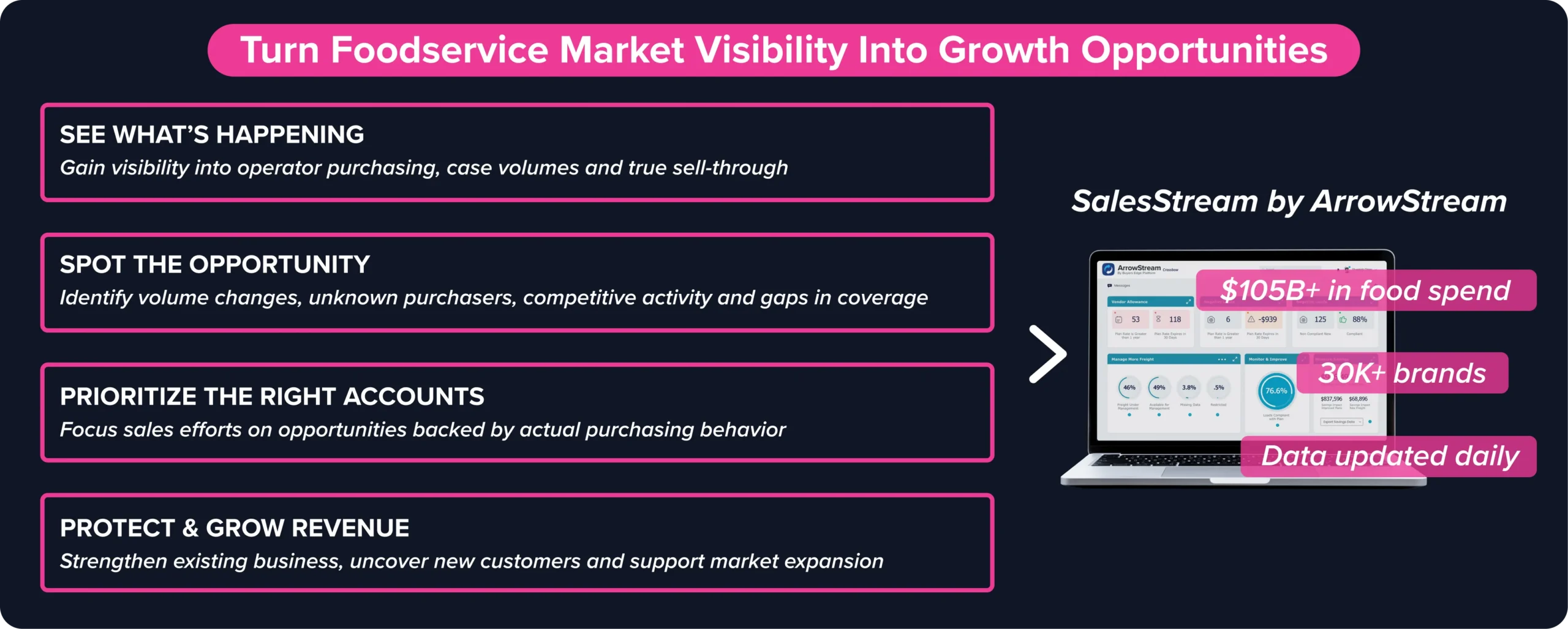
Instead of waiting 60 to 90 days for distributor reporting or piecing together information from different sources, manufacturers can see daily-updated, operator-specific purchasing data across direct and indirect foodservice business.
That can help answer some pretty important questions. Who is actually buying your products? Where is volume changing? Are customers purchasing off contract? Where are competitors gaining ground? And which accounts may be worth more attention from the sales team?
With SalesStream, manufacturers can use those insights to:
- Protect existing revenue. Monitor purchasing behavior and spot volume changes, compliance issues or competitive activity before they turn into larger losses.
- Find new customer opportunities. Identify operators already purchasing products through indirect channels and uncover accounts with potential for additional growth.
- Understand true market potential. Look beyond existing customer lists to see where products are moving, how much operators are purchasing and where there may be gaps in coverage.
- Prioritize sales efforts. Give sales teams more information about an account before the first conversation, so they can spend their time on opportunities backed by actual purchasing behavior.
- Strengthen distributor relationships. Gain a clearer view of distribution activity and use that information to identify areas where additional coverage or collaboration may make sense.
- Benchmark performance. Compare market share and purchasing activity to better understand where the brand is gaining ground and where competitors may be taking share.
SalesStream provides visibility into more than $105 billion in food spend across more than 30,000 brands, with data updated daily.
For manufacturers, that doesn’t have to mean choosing between traditional brokers, distributor relationships or a data-driven sales strategy. Those pieces can work together.
A broker may help open the door. A distributor gets the product where it needs to go. SalesStream can help manufacturers see what’s happening across the market and decide which doors may be worth knocking on next.
Ready to uncover more opportunities in the foodservice market? Click here to learn more about how Buyers Edge Platform can help your business.
FAQs
What is the difference between a food broker and a distributor?
A food broker typically represents manufacturers and helps sell their products to distributors or foodservice operators. A distributor handles the physical product, including purchasing, warehousing and delivering it to customers.
How much do food brokers charge manufacturers?
Food broker costs vary by agreement, market and services provided. Many brokers work on a sales commission, while others may use retainers, fees or a combination of compensation structures.
Do manufacturers need a food broker to sell to restaurants?
No. A food broker is one way for manufacturers to reach restaurant and foodservice customers, but it isn’t the only option. Manufacturers may also sell through internal sales teams, distributors, GPO relationships and other foodservice networks.
What is the difference between a food broker and a GPO?
A food broker generally represents a manufacturer and helps generate sales. A GPO aggregates purchasing demand from participating operators and negotiates purchasing programs with manufacturers and other suppliers.
How do food brokers get paid?
Food brokers are commonly compensated by the manufacturers they represent, often through a commission tied to sales. Compensation arrangements vary and can also include retainers or other fees depending on the agreement.
What alternatives are available to traditional food brokers?
Manufacturers can use internal sales teams, distributor relationships, GPO programs, foodservice purchasing networks and data-driven sales strategies alongside or instead of traditional brokerage. Many manufacturers use a combination of channels to reach more of the foodservice market.