
Written in collaboration with Vegan Hospitality.
Why a vegan menu for restaurants isn’t about trends, it’s about margin strategy.
There’s a revolution happening right under operators’ noses, and it’s not about reinventing the menu. It’s about rethinking what’s already on it. In 2026, nearly half of U.S. restaurant menus feature plant-based items, a figure that reflects roughly a 62 % increase over the last decade and includes vegan options as part of broader plant-positive offerings.
That’s exactly why Vegan Hospitality created Smart Menus, a short-form podcast series built for Buyers Edge Platform operators who want practical ideas they can actually use to increase food sales, without sitting through long webinars or reading dense playbooks.
Diners from flexitarians to curious omnivores increasingly view plant-friendly plates as part of the restaurant experience, which is why a vegan menu for restaurants is becoming a core expectation, not a niche offering.
Because every dish that doesn’t speak to the whole table is essentially a revenue line left unexplored, and a vegan menu for restaurants helps ensure every guest has a reason to order.

When one guest in a group can’t find something they are excited to order, that guest often becomes a veto vote, and the whole party walks to the next restaurant.
Optimizing menus with thoughtful plant-forward options helps to close revenue gaps and future-proofs menus for the diners showing up in greater numbers every year.
Margin Strategy, Not A Full Menu Makeover
Operators don’t always lose profitability in dramatic ways. There are hidden losses that we need to turn our attention to..
A four-top that chooses a competitor because one guest can’t find an option they’re excited about.
A table that skips dessert because not everyone has something to orderd.
A large group that never returns because one diner’s needs felt like an afterthought.
These aren’t isolated incidents. They’re revenue patterns.
When nearly half of U.S. restaurants already offer plant-based items, the competitive landscape has shifted. The question is no longer whether plant-forward options belong on menus. It’s whether your menu captures the full purchasing power of today’s dining groups.
Smart operators understand something critical: plant-forward optimization fits nearly every restaurant concept, and doesn’t take anything away from your traditional customers. Making sure all guests can spend money at your restaurant strengthens your revenue structure, and a well-executed vegan menu for restaurants plays a key role in capturing that full-table spend.
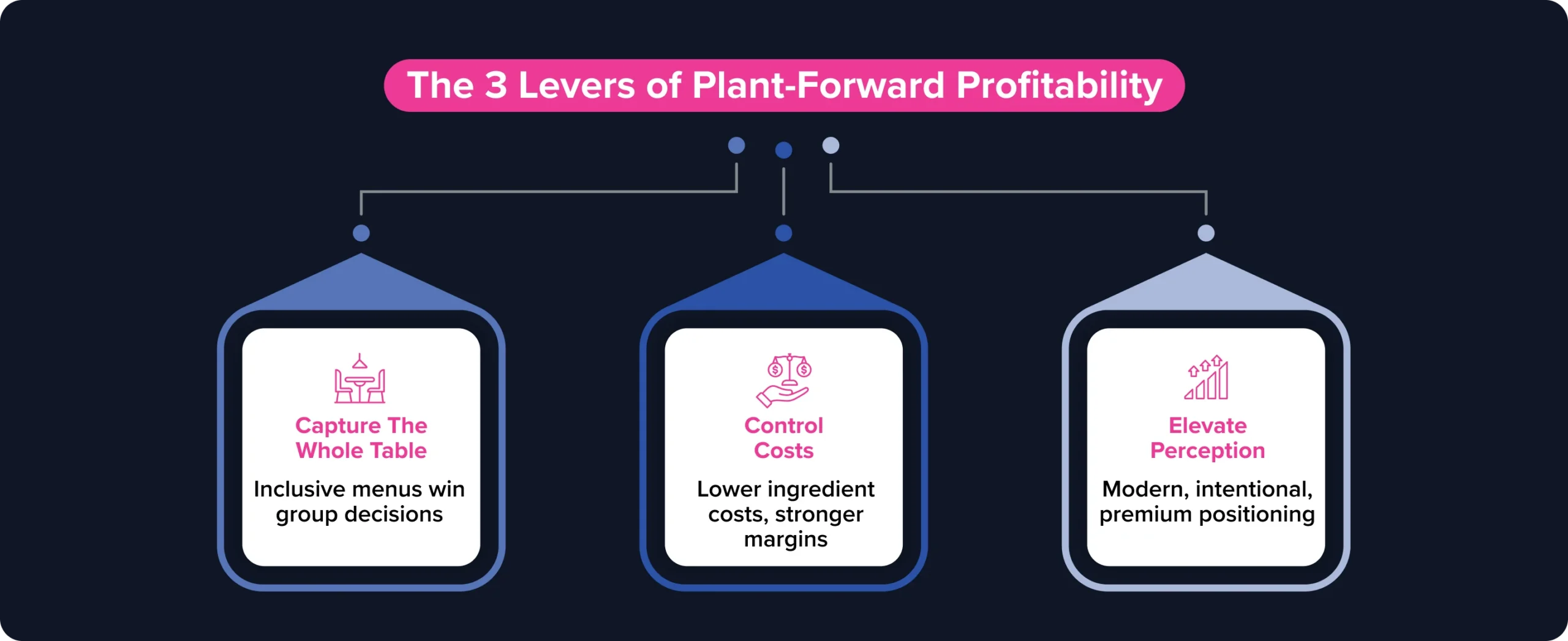
Done strategically, it intersects three powerful business levers at once:
- Group Decision Psychology: Menus that speak to everyone win the whole table. Inclusive options reduce friction in group dining decisions and increase the likelihood of larger party capture.
- Ingredient Cost Control: Many plant-based proteins and dairy alternatives carry lower base costs than traditional animal proteins while maintaining or even elevating perceived value. That creates room for strong contribution margins when priced correctly.
- Premium Perception: Well-executed plant-forward dishes signal culinary intention, health awareness, and modern positioning. When integrated seamlessly, they enhance brand equity.
This is where operators often miscalculate.
Plant-forward strategy is not a “separate section” initiative. It’s a menu architecture decision. When optimized dishes are embedded naturally across categories, guests order them by preference, not necessity.
And that distinction changes order frequency, check averages, and repeat behavior.
The Execution Gap Most Operators Miss
These are the kinds of real-world gaps and opportunities explored in the Smart Menus podcast, where each episode breaks down how small menu decisions translate directly into profitability.
Understanding the opportunity is one thing. Capturing it consistently is another.
Many operators already have plant-based ingredients in-house. They may even have one or two naturally vegan dishes on the menu. But without intentional optimization, those items function as passive options, not active revenue drivers.
The difference between “having a vegan dish” and building a high-performing vegan menu for restaurants comes down to structure.
It’s about:
- How dishes are described and positioned
- Whether plant-forward options match the visual and portion expectations of traditional items
- How seamlessly they are integrated across categories
- Whether staff can confidently recommend them
- Whether ingredient swaps are protecting margin without sacrificing satisfaction
Small adjustments can unlock meaningful financial impact without disrupting your brand identity or kitchen workflow.
And when those adjustments are executed with intention, the results compound:
- Higher contribution margins on optimized dishes.
- Greater full-party capture rates.
- Stronger repeat visitation from mixed dietary groups.
- Increased social visibility for visually compelling plant-forward plates.
Want to hear how operators are applying this in real kitchens? The Smart Menus podcast breaks it down episode by episode, and you’re invited to start listening today.
What This Means for Foodservice Operators
The market has already shifted.
Nearly half of restaurants have integrated plant-based items. Flexitarian ordering is normalized. Younger diners expect inclusivity as part of hospitality, not as a special request.
The competitive edge no longer comes from simply adding an item with a symbol next to it.
It comes from engineering your menu so that:
- No guest becomes a veto vote
- No opportunity for margin expansion is overlooked
- No dish feels like an afterthought
- No revenue leak goes unaddressed
Operators who treat plant-forward strategy as a structured margin initiative, rather than a trend response, will outperform those who approach it casually.
Because the advantage isn’t in announcing change. It’s in embedding it.
And when done strategically, the impact extends beyond food cost.
It shows up in table capture.
In check averages.
In repeat visits.
In brand positioning.
It shows up on the bottom line.
Ready to Unlock the Hidden Revenue Lever?
Vegan Hospitality, in partnership with Buyers Edge Platform, created Smart Menus, a short, actionable podcast series designed to help operators turn plant-forward ideas into real margin impact.

Each episode is built to fit into your day and focuses on practical ways to:
- Identify low-effort, high-impact menu opportunities
- Strengthen margins without overhauling your concept
- Integrate plant-forward options in ways guests actually order
- Equip your team to confidently recommend optimized dishes
The goal isn’t more theory. It’s better execution.
Frequently Asked Questions
Do plant-forward menu items actually improve restaurant profitability?
They can, when done right. Many plant-based ingredients come at a lower cost than traditional proteins, but still support strong menu pricing. The real win comes from capturing more of the table. When every guest finds something they want, you protect revenue that might otherwise walk out the door.
Do I need to add a separate vegan section to my menu?
Not necessarily. In fact, that’s often where operators miss the mark. The strongest approach is integrating plant-forward options naturally across your menu. When dishes feel like part of the overall experience instead of a niche category, guests are more likely to order them without hesitation.
What’s the easiest way to start adding plant-forward options?
Start with what you already have. Look at dishes where a simple swap or adjustment could work, like a dairy-free sauce or a plant-based protein alternative. Small changes tend to have the biggest impact because they don’t disrupt your kitchen or your brand.
Will plant-forward dishes appeal to guests who aren’t vegan?
Yes, and that’s the opportunity. Most demand is coming from flexitarians, not strict vegans. These guests aren’t looking for labels, they’re looking for options. If a dish sounds great and fits their preferences, they’ll order it regardless of how it’s categorized.
How can I make sure my team actually sells these items?
It comes down to confidence and familiarity. If your staff understands the dish, can describe it well, and knows when to recommend it, it becomes part of the natural flow of service. A quick pre-shift rundown or tasting can make a noticeable difference in how often these items get ordered.