Foodservice has never been short on challenges, but the pace of change right now is hard to ignore. Costs are volatile. Labor is tight. Supply chains are still anything but predictable. To keep up, operators and food manufacturers are turning to smarter tools that help them plan ahead instead of reacting after the fact. One of the biggest shifts happening behind the scenes is the growing use of AI in food technology, especially in areas like forecasting, purchasing, food safety, and menu planning.
Rather than replacing experience or operational know-how, AI is increasingly being used to support it. When applied correctly, it gives food businesses clearer visibility into what is happening across their operation and what is likely to happen next.
AI in Food Technology
AI in food technology uses operational data and past patterns to help teams make decisions earlier, not after issues have already surfaced. It goes beyond reporting what happened and supports more proactive planning.
In foodservice and manufacturing, this usually shows up in small, practical ways. Purchasing data is easier to follow. Inventory is clearer at a glance. Forecasts feel more grounded in what’s actually happening on the floor. For teams managing multiple locations, suppliers, or large SKU counts, that clarity removes a lot of daily pressure.

The result is fewer fire drills. Pricing issues get caught sooner. Orders line up more closely with real movement. Compliance checks feel manageable instead of rushed. Those small changes add up over time to make operations more predictable and margins more stable.
Role of AI Across the Food Value Chain
The food value chain is complex, and it becomes harder to manage as operations grow. Ingredients move through multiple hands before reaching a kitchen or production line, and early decisions can affect everything from production timing to menu availability.
AI helps reduce how scattered that information usually is. Instead of stitching together data from different systems, teams can work from a clearer view across sourcing, production, and distribution.
For operators, that means spotting supplier issues sooner. For manufacturers, it supports production planning based on what customers are actually buying. The goal isn’t perfect certainty, but earlier visibility and fewer downstream problems when conditions change.

Core Applications
AI shows up in foodservice and manufacturing in small, practical ways. It’s rarely one big system. More often, it’s a set of tools that help different parts of the operation run a little smoother.
Supply Chain Optimization
Supply chain issues usually build quietly before they show up as real problems. AI is most useful when it helps teams notice those patterns sooner.
Common examples include:
- Ordering levels that don’t line up with actual usage
- Pricing or fill-rate inconsistencies from suppliers
- Adjustments based on seasonality or recent sales shifts
- Fewer last-minute substitutions caused by avoidable stockouts
Catching these earlier gives teams more room to adjust without scrambling.
Quality Control and Food Safety
Food safety doesn’t usually fall apart in big, obvious ways. It slips when information lives in too many places and small details get missed during a busy shift.
AI helps bring those details back into focus. Instead of relying on clipboards, memory, or end-of-day reviews, teams can use AI-powered tools to:
- Keep temperature and handling data organized and easier to review
- Flag unusual patterns before they turn into real issues
- Strengthen traceability from supplier to facility
- Spend less time chasing paperwork after the fact
This isn’t about reinventing food safety programs. It’s about giving operators clearer visibility so those programs actually work in real kitchens, on real days.
New Product Development
New products are always a bit of a gamble. Most teams want fewer surprises before they commit time, labor, and ingredients.
What usually helps in practice:
- Looking back at how similar items actually performed
- Noticing when ingredient costs tend to swing
- Seeing which regions or seasons supported demand
- Cutting ideas earlier that don’t show much traction
None of this replaces judgment. It just makes it easier to decide where to spend time and where not to.
Food Service Automation
The biggest value of automation is time. AI-supported tools help reduce repetitive work that slows teams down.
This often shows up as:
- Simpler ordering workflows
- Better inventory accuracy across locations
- Less manual reconciliation between systems
- More consistent scheduling and prep planning
When routine tasks take less effort, teams can focus more on execution and service.
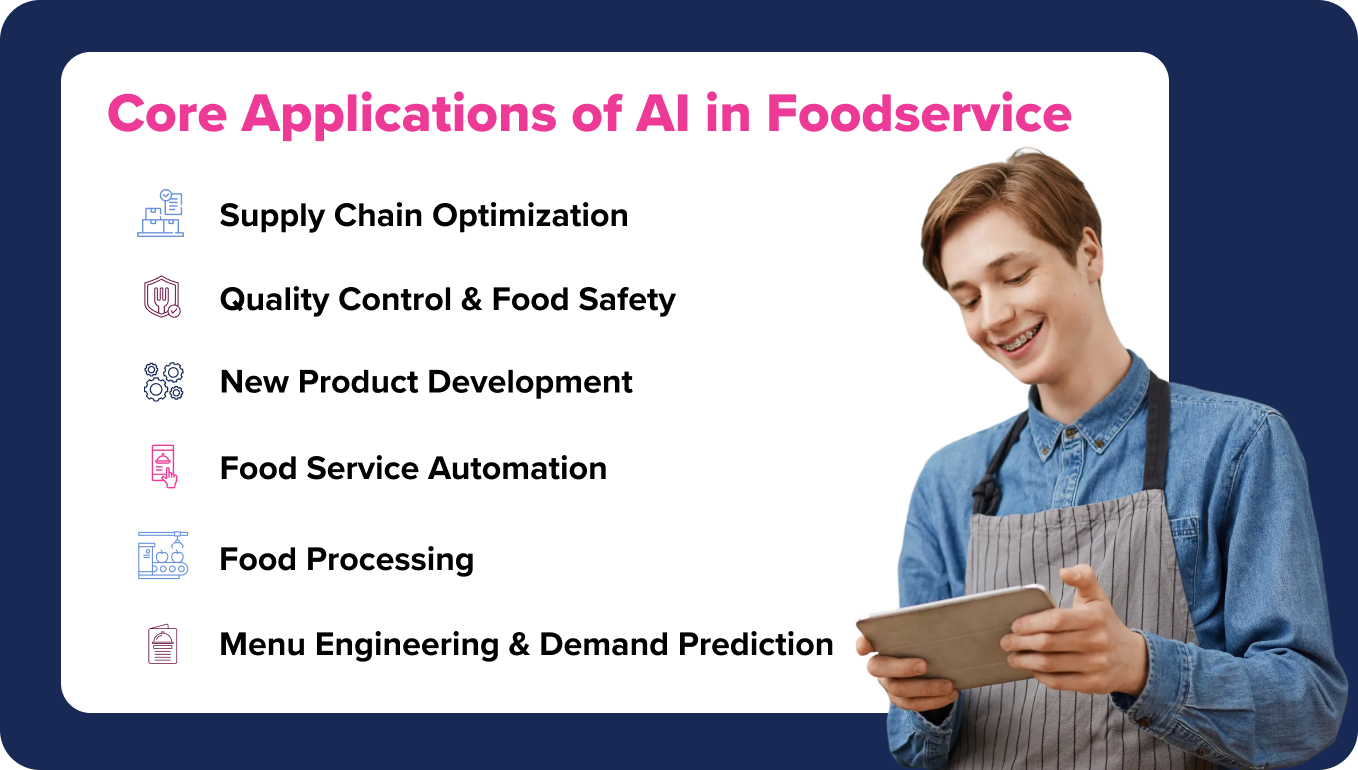
Food Processing
In processing environments, reliability matters. AI helps teams understand where inefficiencies tend to occur.
Common uses include:
- Flagging maintenance needs before failures happen
- Identifying slowdowns tied to specific inputs
- Smoothing production schedules
- Reducing unplanned downtime
The benefit is steadier output and fewer disruptions.
Menu Engineering and Demand Prediction
Menus are shaped by more than popularity alone. Costs, prep time, and demand all factor in.
AI supports menu decisions by helping teams:
- See which items consistently perform well
- Identify underperforming dishes earlier
- Align prep and purchasing with real demand
- Reduce waste tied to overproduction
Better information doesn’t eliminate uncertainty, but it makes decisions easier to stand behind.
Benefits of AI in Food Technology
Most teams don’t talk about AI in terms of benefits. They talk about what feels different a few months in. The work changes in small ways that are hard to quantify but easy to notice once they’re gone.
Increased Operational Efficiency
There’s less back-and-forth trying to answer basic questions. Fewer spreadsheets get passed around. Fewer meetings end with “let’s check on that and circle back.”
Reduction in Food Waste
Prep feels tighter. Ordering stops leaning on buffer inventory “just to be safe.” Products move through faster, and less gets written off at the end of the week.
Smarter Business Decisions
Decisions don’t stall as often. When something shifts, teams adjust instead of debating whether the data is trustworthy enough to act on.
Improved Food Quality
Execution stays more consistent even when there are changes in staff or a lot of work to do. Standards stay in place without anyone having to step in all the time to fix things.
Enhanced Food Safety Standards
Reviews seem more like something that needs to be done than something that needs to be done right away. Before they cause audits or emergency fixes, possible problems are dealt with.
Sustainable Food Production
Less waste, fewer reworks, and tighter processes usually take care of sustainability without making it a separate project that teams have to manage.
Challenges of Implementing AI in Food Technology
AI doesn’t fail because the technology is bad. It usually struggles because real operations are messy, timelines are tight, and data isn’t always ready for prime time.
High Maintenance and Upgrade Costs
Costs don’t stop after implementation. Systems need updates. Teams need training. Small changes turn into ongoing line items if expectations aren’t set early.
Operational Disruption
Even good tools can slow things down at first. Workflows shift. People have to learn new processes while still keeping the operation running.
Data Quality and Accuracy Issues
AI doesn’t magically clean up data that’s been neglected for years. If item names are inconsistent, invoices don’t line up, or usage data hasn’t been reviewed in a while, those problems show up fast. Teams usually notice this when numbers don’t quite match expectations and someone has to stop and ask, “Does this actually look right?”
Data Privacy and Cybersecurity Risks
As more systems get connected, more people start asking who has access to what. Purchasing data, pricing details, and operational information suddenly matter beyond day-to-day use. Managing permissions and security becomes part of the conversation, not something that can be handled later.
Technical Downtime and System Failures
Even solid systems have off days. Tools go down. Reports don’t load. Integrations lag. When that happens, teams still need a way to keep work moving without everything grinding to a halt.
Regulatory and Compliance Challenges
Food businesses don’t operate under one set of rules. Requirements change depending on location, segment, and product type. Technology has to fit inside those guardrails, which sometimes means slowing down implementation or adjusting how tools are used.
The Future of AI in Food Technology
The future of AI in food technology isn’t about replacing people or removing judgment from the process. It’s about narrowing the gap between what teams know and what they can actually act on in time.
As AI becomes more embedded in everyday systems, it’s likely to fade further into the background. Instead of standing out as a separate tool, it becomes part of how purchasing decisions are made, how inventory is reviewed, and how issues get flagged earlier than they used to. The value comes from fewer surprises and more control, not from flashy features.
Where this goes next depends less on the technology itself and more on how well data is connected across the business. When purchasing, inventory, forecasting, and operational data work together, teams spend less time reacting and more time planning. That kind of visibility is what allows food businesses to stay flexible, even when conditions change quickly.
This is where foodservice experts like Buyers Edge Platform fit into the picture. Bringing data together across systems and pairing it with industry experience helps teams turn information into decisions they can actually stand behind.
FAQs
How is AI improving food safety?
AI supports food safety by making it easier to spot potential issues earlier. Instead of relying only on periodic checks, teams can review patterns in temperature data, handling records, and compliance activity before small gaps turn into larger problems.
Can AI reduce food waste in the supply chain?
Yes. When ordering, production, and prep are better aligned with actual demand, less product sits unused. Over time, that leads to tighter inventory movement and fewer write-offs tied to overproduction or spoilage.
What are the risks of using AI?
The biggest risks usually aren’t technical. They tend to involve data quality, implementation costs, and adoption challenges. Without clean data and clear expectations, teams may struggle to trust or fully use the outputs.
Is AI suitable for small food businesses?
AI isn’t limited to large organizations anymore. Many tools are scalable and can support smaller teams, especially when the focus is on improving visibility and reducing manual work rather than adding complexity.
Will AI change the future of food consumption?
AI is more likely to influence how food is produced, managed, and priced than how consumers choose what to eat. Its biggest impact stays behind the scenes, shaping operations rather than preferences.