

Margins are tight. Food and labor costs fluctuate. Guest expectations continue to rise. In that environment, instinct alone is not a strategy.
Tracking the right restaurant KPI metrics gives operators clarity. It turns assumptions into measurable insights and helps leadership teams focus on what actually drives profitability. Whether you operate a single independent restaurant or manage multiple locations, understanding your restaurant KPIs is one of the most effective ways to protect your bottom line and scale with confidence.
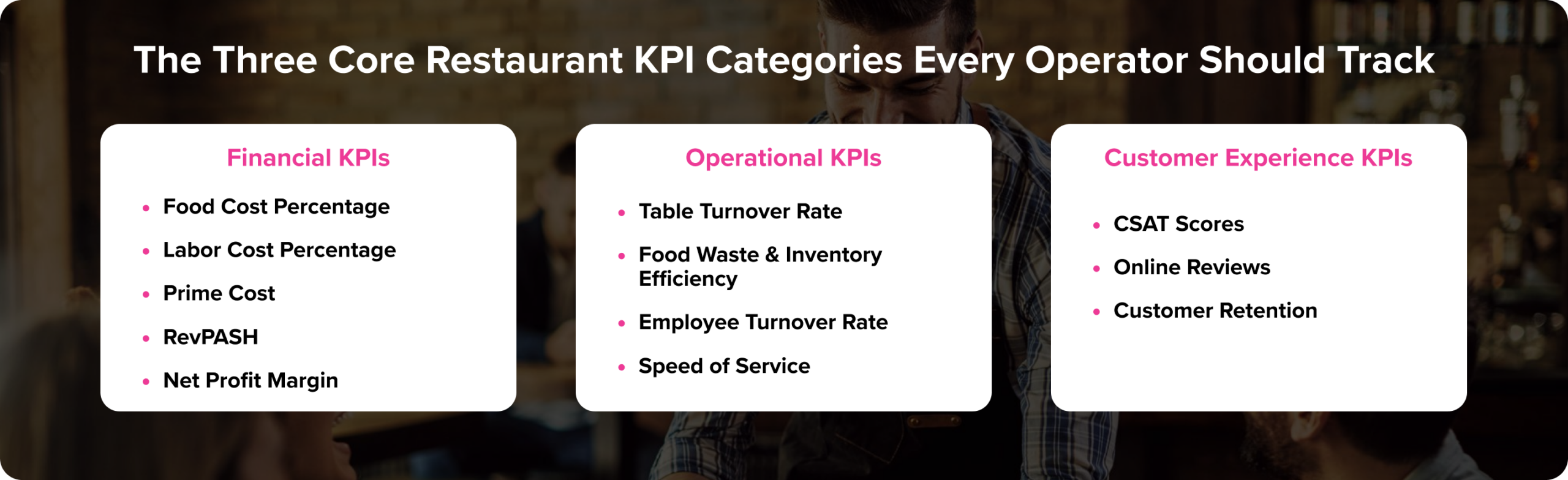
Below is a practical breakdown of the most important restaurant KPI categories, why they matter, and how to use them to improve performance.
Why Tracking KPIs is Crucial for Restaurants
A restaurant KPI is more than just a number on a screen. It is a way to measure how well your business is doing in important areas like finance, operations, and customer service. When you keep track of them all the time, KPIs become the basis for making smart choices.
Making Data-Driven Decisions for Profitability
Data, not guesswork, is what successful operators use. You can do the following by keeping track of each restaurant’s KPI:
- Find out about margin erosion early
- Change prices based on changes in costs
- Make the most of scheduling during slower shifts
- Look at how promotions affect your finances.
When you know how your restaurant’s key performance indicators (KPIs) affect its bottom line, you can take action before problems show up in your profit and loss statement.
Identifying Operational Strengths and Weaknesses
Operational metrics show you what is working and what needs to be fixed. A rise in the percentage of labor costs, a fall in the table turnover rate, or an increase in food waste are all signs of a restaurant’s key performance indicators (KPIs).
These signs help management teams find problems before they turn into costly habits.
Improving Customer Experience and Loyalty
Not all of the key performance indicators (KPIs) for restaurants are financial. It’s just as important to have happy customers, get them to come back, and get good reviews online.
Keeping an eye on performance indicators related to the guest experience makes sure that operational efficiency never means lower service quality.
Financial KPIs Every Restaurant Should Monitor
If you want to know whether your restaurant is actually healthy, the financial restaurant KPI metrics tell the real story. Sales alone don’t mean much if costs are quietly climbing behind the scenes.
These are the numbers experienced operators look at first.
Food Cost Percentage
Food cost percentage is one of the most talked-about restaurant KPI metrics for a reason. It shows how much of your food revenue is being spent on ingredients.
The basic formula is simple:
(Cost of Goods Sold ÷ Food Sales) × 100
But the implications are anything but simple.
If your food cost percentage creeps up even one or two points, that is rarely random. It usually points to something specific: portion creep in the kitchen, vendor price increases, waste from over-prepping, or menu items that are underpriced.
In high-volume restaurants, small shifts in this restaurant KPI can translate into tens of thousands of dollars over the course of a year. That is why disciplined operators review it consistently instead of waiting for month-end surprises.
Labor Cost Percentage
Labor is typically your other major controllable expense. Tracking labor cost percentage as a restaurant KPI shows how much of your revenue is being spent on wages, payroll taxes, and benefits.
In many full-service concepts, labor lands somewhere between 30% and 35% of sales. Quick-service and fast-casual models may run differently, but the principle is the same.
When this restaurant’s KPI starts rising, the questions usually follow:
- Are we overstaffed on slower shifts?
- Is overtime creeping in?
- Are managers scheduling based on habit instead of forecasted sales?
Labor and food costs rarely move in isolation. When both rise at the same time, margins compress quickly. Watching this restaurant’s KPI weekly helps you correct course before it becomes a bigger issue.
Prime Cost
Prime cost combines food cost and labor cost. Many operators consider this the most famous restaurant KPI because it captures your two biggest controllable expenses in one number.
If the prime cost is out of line, profitability becomes difficult, no matter how strong your sales are.
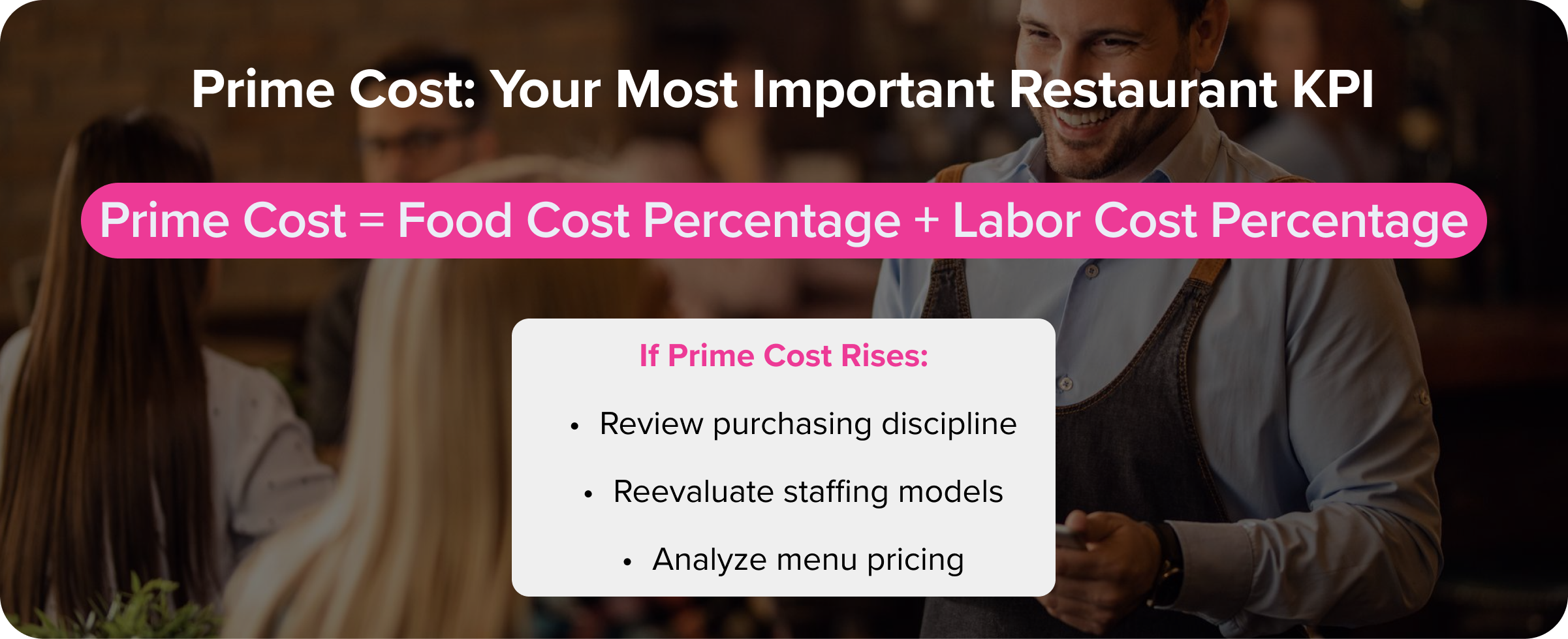
Healthy concepts often aim to keep prime cost in the 55% to 65% range, though that varies by service style and pricing model. The goal is not to chase a universal number. It is to understand what is sustainable for your concept and monitor the restaurant KPI consistently.
When prime cost drifts upward, it forces meaningful conversations about purchasing discipline, staffing models, and menu engineering.
Revenue Per Available Seat Hour (RevPASH)
RevPASH sounds technical, but it answers a very practical question: Are you maximizing the revenue potential of your dining room?
This restaurant KPI looks at how much revenue each available seat generates per hour. It is particularly useful for full-service restaurants where capacity and pacing directly affect revenue.
RevPASH helps you evaluate:
- Whether peak hours are truly optimized
- If pricing aligns with demand
- Whether certain dayparts are underperforming
For restaurants with limited space, improving this restaurant KPI can drive growth without adding square footage.
Net Profit Margin
At the end of the day, net profit margin tells you what is actually left over.
Many restaurant KPIs focus on individual pieces of the puzzle. Net profit margin shows whether those pieces are working together effectively.
You can improve food cost and tighten labor, but if rent, utilities, and other overhead expenses are climbing unchecked, the final number may still disappoint.
This restaurant KPI forces leadership to look at the entire operation, not just one line item.
Operational KPIs for Efficient Restaurant Management
Financial restaurant KPI metrics tell you what happened. Operational KPIs help you understand why.
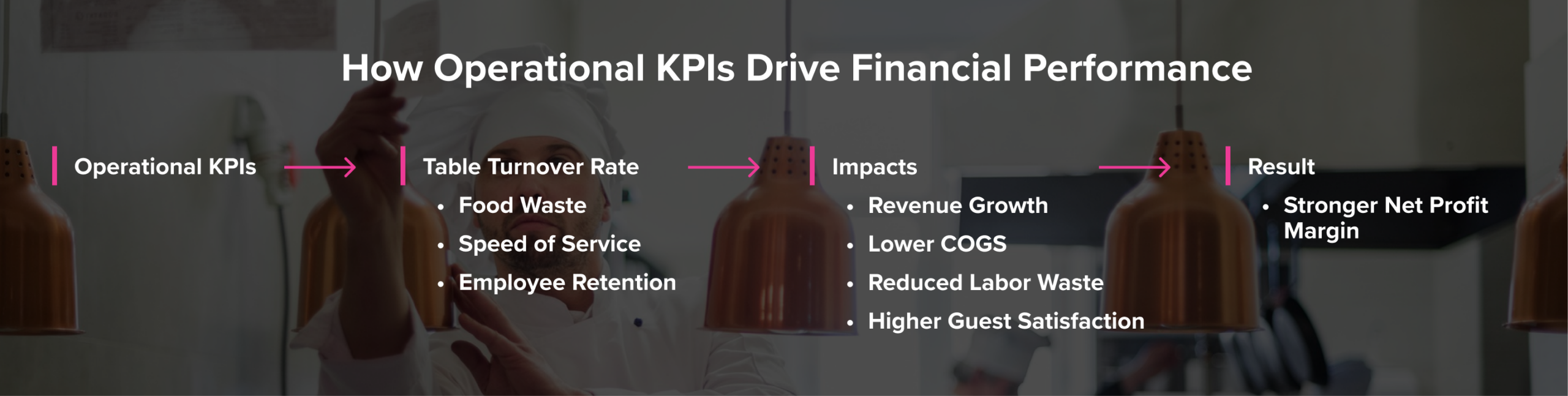
These indicators reveal how well your systems and teams execute day to day.
Table Turnover Rate
Table turnover rate measures how often a table is seated and re-seated during a shift.
Improving this restaurant’s KPI can increase revenue without expanding your footprint. However, pushing turnover too aggressively can damage the guest experience.
The key is balance. Efficient pacing, well-trained servers, and smooth kitchen coordination all influence this metric. When turnover improves naturally because operations are streamlined, revenue follows.
Food Waste and Inventory Efficiency
Food waste is one of the quietest margin killers in the business.
Tracking food waste as a restaurant KPI helps identify patterns:
- Over-ordering
- Inaccurate prep forecasting
- Poor storage practices
- Inconsistent portion control
Inventory efficiency metrics add another layer. They show whether your cash is sitting on shelves or moving efficiently through the operation.
Even modest improvements in this restaurant’s KPI can significantly reduce unnecessary spending.
Employee Turnover Rate
A lot of employees leaving is costly. It takes time and money to hire, onboard, and train new team members.
Keeping an eye on employee turnover as a restaurant KPI can tell you a lot about the culture at work, how schedules are made, and how well management is doing.
When turnover goes up, it’s often a sign that something else needs to be looked at. Stable teams tend to give guests a better experience more often, which has a direct effect on other restaurant KPIs.
Speed of Service and Order Accuracy
Order accuracy and speed of service may seem like basic operational metrics, but they affect both revenue and guest satisfaction at the same time.
Slow service means fewer table turns. When orders are wrong, more food is wasted, and it costs more to make them again. Both have an effect on profits.
Tracking these operational restaurant KPI metrics gives managers clear coaching opportunities and shows them where the workflow is slowing down that they might not have seen before.
Customer Experience KPIs
Important restaurant KPIs include strong financial and operational metrics. But guest loyalty is what will make you successful in the long run.
Customer-focused KPIs show how happy guests are with their stay.
Customer Satisfaction Scores (CSAT)
Customer satisfaction surveys give you direct feedback on how guests feel about the food, service, cleanliness, and overall value.
This restaurant KPI helps managers see how changes to the way things are done affect the guest experience. For instance, cutting back on staff too much might save money but hurt the quality of service.
CSAT links decisions made in the business to real feedback from guests.
Online Reviews and Ratings
More than ever, online ratings affect where people eat.
Reviews aren’t always thought of as a traditional restaurant KPI, but they do show how well the restaurant is doing in real time. Before they show up in financial reports, changes in ratings can show problems with service, menu items, or operations.
Management can respond strategically instead of reactively by keeping an eye on this restaurant’s KPI.
Customer Retention and Repeat Visits
Getting new guests costs a lot of money. Keeping the ones you already have is much more profitable.
Keeping track of repeat visits as a restaurant KPI shows you if your idea is making people loyal or if you’re relying too much on one-time visitors.
Consistent retention usually means that the quality of the food, the level of service, and the overall value are all in line.
How to Use KPIs to Improve Your Restaurant
The first step is to gather data on restaurant KPIs. When you use it on purpose, it gets better.
Set Realistic Benchmarks and Targets
Each restaurant idea works in its own way. Instead of trying to meet industry averages, look at how each restaurant’s KPIs compare to your past performance and the competition.
Your team’s goals should be hard but not impossible to reach.
Compare Performance Across Shifts or Locations
For brands with more than one location, comparing restaurant KPIs across locations often reveals useful information.
One store might be better at managing its workers. Another may do better on RevPASH. Leadership can copy best practices once they know what these differences are.
Even operators with only one location can look at how well lunch and dinner do to find chances.
Identify Trends Instead of Reacting to Daily Changes
The performance of restaurants changes from day to day. The weather, events, and the time of year all have an effect.
Instead of reacting to every small change, look at restaurant KPI trends over weeks or months. Patterns that last are more important than single data points.
Best Practices for Monitoring Restaurant KPIs
A restaurant KPI becomes a strategic tool instead of a report that no one remembers when it is consistent.
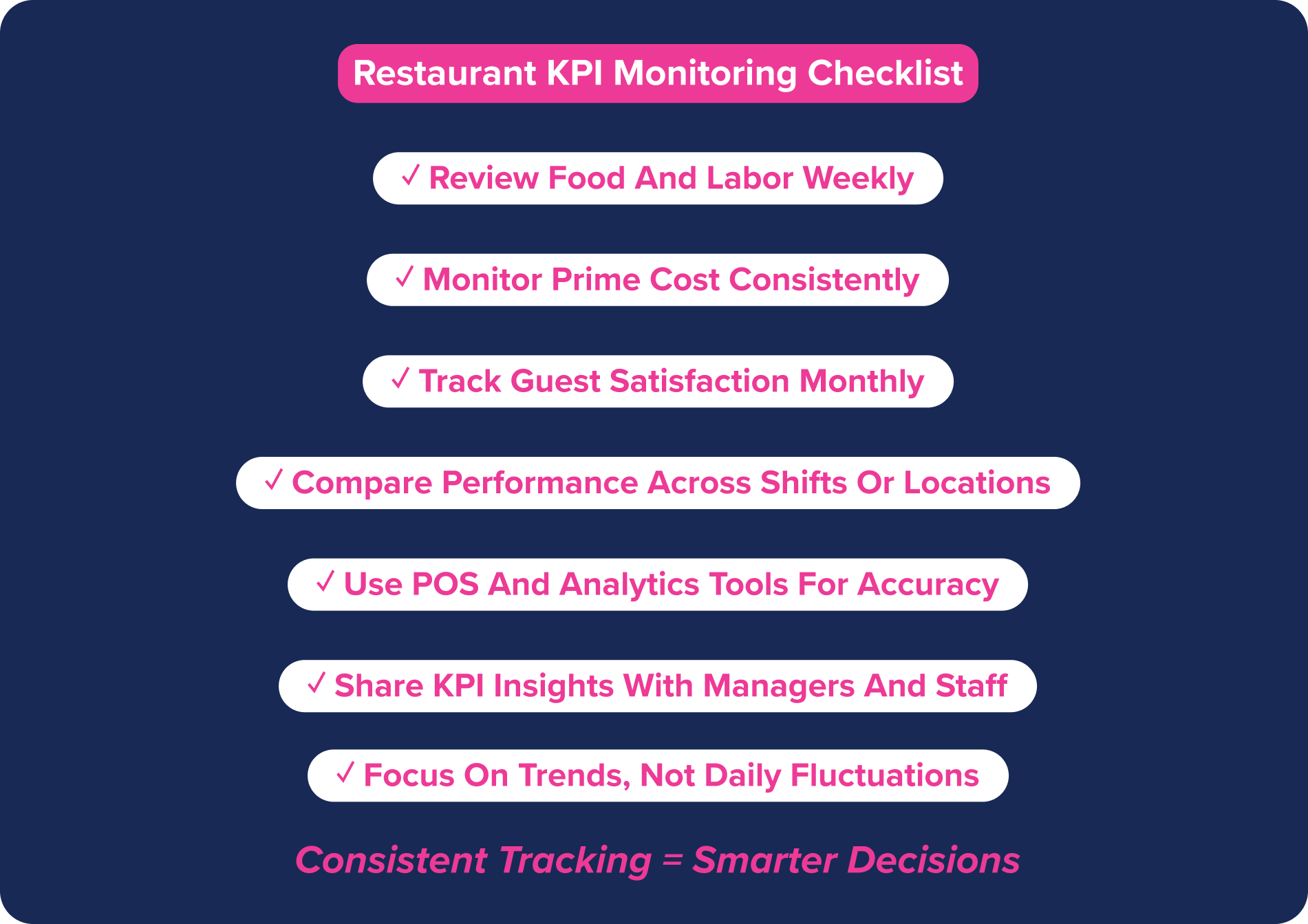
Track Metrics Weekly or Monthly
It’s helpful to look at some restaurant KPIs, like food cost and labor cost, every week. Some things, like net profit margin, might be better to look at once a month.
Rhythm is the key. Tracking that isn’t done regularly limits understanding.
Use POS and Analytics Tools for Data Accuracy
It’s easy to make mistakes when you use a manual spreadsheet. Modern POS systems and analytics platforms make it easier to keep track of restaurant KPIs and give you cleaner, more reliable data.
Better decisions come from having accurate data.
Share Insights with Staff for Alignment
Many restaurant KPIs are affected by employees on the front lines.
When teams know how portion control affects the cost of food or how service pacing affects table turnover, they are more likely to be responsible. Being open and honest often leads to better results than just giving orders from the top down.
Continuously Refine Strategies Based on Trends
As your restaurant idea grows, the way you track KPIs should change.
The menus change. Job markets change. Expectations of guests change. Checking your KPIs on a regular basis makes sure they are still in line with your current strategy and not old assumptions.
Final Words
Running a restaurant without tracking the right restaurant KPI metrics is like navigating without a dashboard.
Food cost, labor percentage, prime cost, turnover rates, and guest satisfaction metrics all work together to tell a complete story. When monitored consistently, these restaurant KPIs provide clarity in an industry where margins are tight and volatility is constant.
Operators who treat KPI tracking as a discipline rather than an afterthought are better positioned to protect profitability and scale sustainably.
FAQs
What are restaurant KPIs and why are they important?
Restaurant KPIs are measurable performance indicators that track financial health, operational efficiency, and guest satisfaction. They matter because they give an objective view of what is working and what needs to be better.
Which financial KPIs should restaurants track?
Restaurants should always keep an eye on their net profit margin, prime cost, revenue per available seat hour, food cost percentage, and labor cost percentage. These restaurant KPI metrics give a clear picture of how well the business is doing financially.
How can table turnover rate impact restaurant efficiency?
The rate at which tables turn affects how well you use your seating capacity. Improving this restaurant’s KPI can increase the amount of money it can make, as long as it doesn’t hurt the experience of the guests.
What operational KPIs help reduce food waste?
Tracking food waste, making sure that inventory is used efficiently, keeping an eye on portion sizes, and making sure that orders are correct are all operational restaurant KPIs that help cut down on spoilage and extra costs.