

Every smart business decision in a hotel is based on hotel accounting. Strong accounting practices give hotel managers the financial information they need to stay profitable in a business that changes quickly. This includes keeping track of room revenue, food costs, labor costs, and vendor costs.
Hotels are different from other businesses in that they are open 24 hours a day, have multiple sources of income, and have to deal with constant price changes. That makes hotel accounting more important and more difficult. It makes things clear when done right. When done wrong, it makes blind spots that slowly eat away at margins.
This guide explains the basics of hotel accounting, important financial metrics, common problems, and best practices that help hospitality teams see and control their finances better.
What is Hotel Accounting?
Hotel accounting is a branch of accounting that deals with keeping track of, analyzing, and reporting the financial activities of a hotel or other hospitality business. It keeps track of more than just basic bookkeeping. It also keeps track of room revenue, food and drink operations, labor allocation, vendor contracts, and daily cash flow.
Hotel accounting needs to be very detailed, accurate, and consistent in its reporting in order to show the true financial performance of the hotel. This is because hotels make money in many different areas. The goal is not just to follow the rules, but to understand them. Strong hotel accounting helps owners and managers know where money comes from, where it goes, and where they can make more money.
How Hotel Accounting Works?
Hotel accounting doesn’t happen once a month. It happens every day. Rooms sell overnight, late charges roll in, and revenue keeps moving even after the front desk slows down.
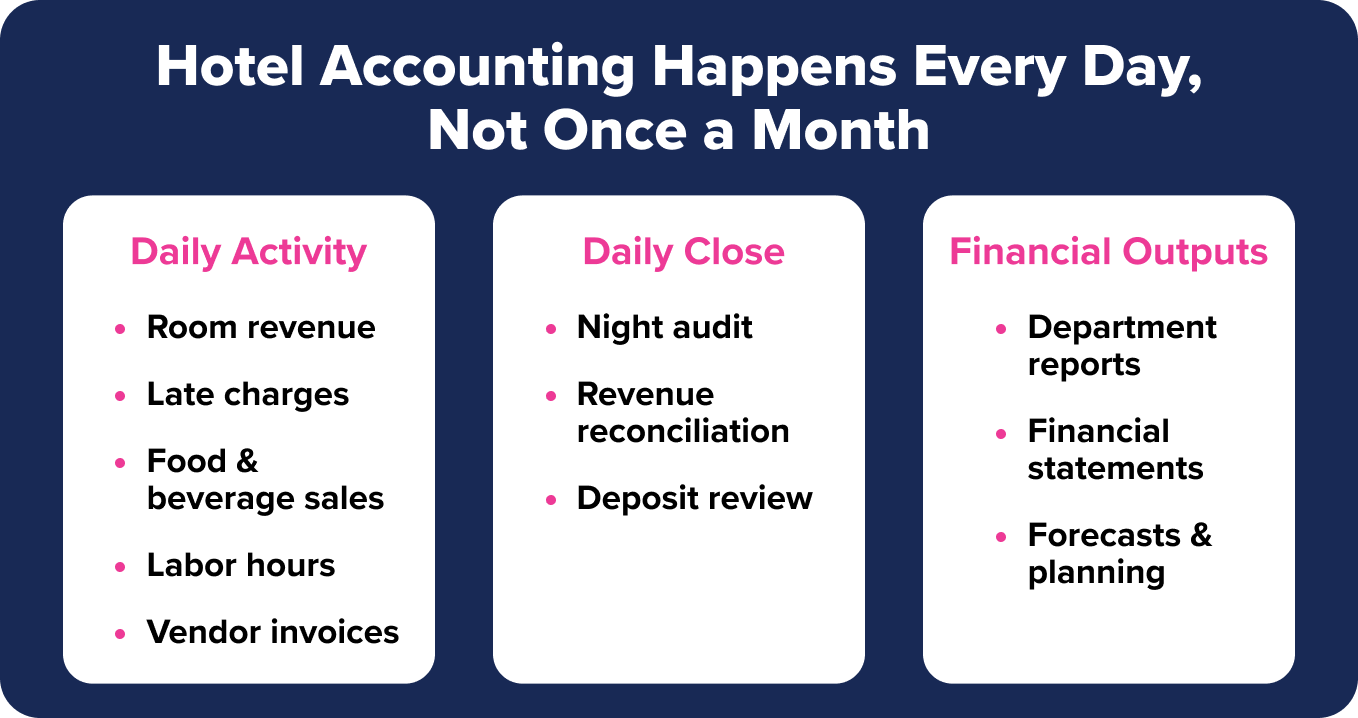
Each day starts with closing out the last one. Night audits clean up transactions, and accounting teams review deposits, labor, and invoices to make sure everything lands where it should.
Over time, those daily details turn into reports and forecasts. When hotel accounting works, the numbers match what’s actually happening on property. When it doesn’t, the gaps show up fast.
Key Financial Statements Used in Hotel Accounting
Income Statement (Profit and Loss)
The income statement shows how much money a hotel makes and spends over a certain time period. In hotel accounting, this statement often shows how much money each department makes and spends, giving a clear picture of the rooms, food and drink, and other areas of operation.
Balance Sheet
A hotel’s balance sheet shows how much money it has and how much it owes at a certain point in time. It shows assets, liabilities, and equity, which helps leaders figure out how much money they have, what debts they have, and how healthy their finances are as a whole.
Cash Flow Statement
Cash flow is very important in hotel accounting because there are so many transactions every day. This statement shows how money flows through the business, making sure the hotel can pay its employees, its suppliers, and make investments in its operations.
Supporting Schedules and Financial Notes
Supporting schedules give financial statements more meaning. These could be things like labor reports, food cost breakdowns, and vendor spend summaries that help explain how things are going and point out problems that are starting to happen.
Core Hotel Accounting Metrics That Drive Visibility
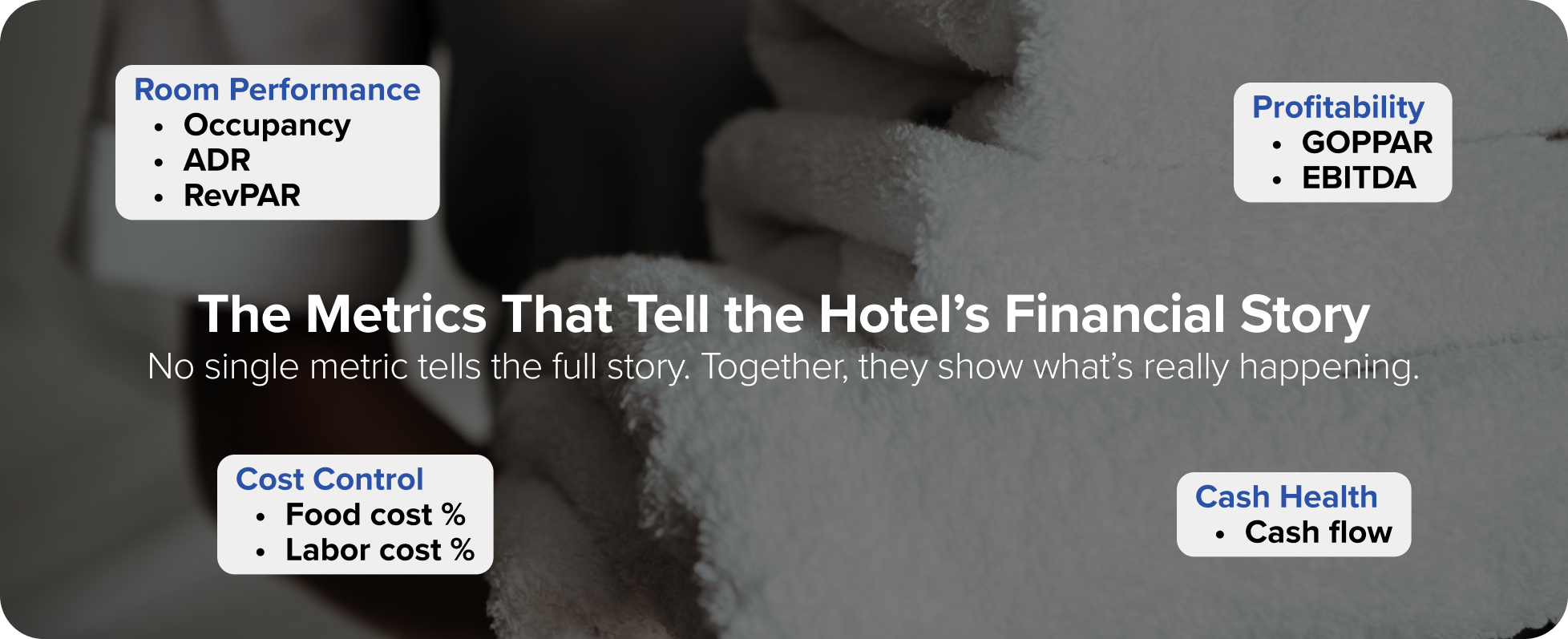
Hotel accounting metrics aren’t just numbers on a report. They’re signals. When you know how to read them together, they tell a clear story about what’s working, what’s drifting, and where attention is needed before margins start slipping.
Occupancy Rate and Average Daily Rate (ADR)
Occupancy and ADR are usually the first numbers hotel teams look at, and for good reason. Occupancy shows how full the house is. ADR shows how much each occupied room is earning. On their own, they’re helpful. Together, they explain why revenue is moving the way it is.
A full hotel with a soft ADR tells a very different story than a slightly emptier hotel holding strong rates. Hotel accounting uses both metrics to balance volume and pricing instead of chasing one at the expense of the other.
Revenue per Available Room (RevPAR)
RevPAR pulls occupancy and ADR into a single, easy-to-compare number. It answers a simple question: how much revenue is each available room actually producing?
Because it smooths out the daily ups and downs, RevPAR gives teams a steadier way to see what’s actually happening with room revenue. One busy weekend or one slow weekday won’t skew the picture. Instead, it helps hotel accounting teams step back, look across weeks or months, and ask better questions about pricing, demand, and booking behavior.
Gross Operating Profit per Available Room (GOPPAR)
GOPPAR is where things get real. It doesn’t just ask how much revenue came in. It asks what was left after the hotel paid to operate.
This metric is often the one that explains why a strong top line doesn’t always feel like a strong month. Rising labor, higher food costs, or creeping operating expenses show up quickly here. In hotel accounting, GOPPAR is a practical check on whether revenue growth is actually translating into profit.
Food and Labor Cost Percentages
Food and labor costs are where many hotel margins are won or lost. These expenses move constantly, influenced by staffing levels, purchasing decisions, and volume shifts.
When teams keep track of these percentages in hotel accounting, they can tell if rising costs are due to business growth or problems with how things are run. When there is a lot of volume, even small changes can add up quickly.
EBITDA and Cash Flow Indicators
Teams can take a step back and see the bigger picture with EBITDA and cash flow. They help you see how the hotel is really doing over time by smoothing out the ups and downs of the day-to-day.
These numbers are important for owners and finance leaders because they help them make big decisions like when to invest, how to handle debt, and whether the business is making enough money to support its future plans. When hotel accounting is working properly, the daily choices about the property are clearly linked to the long-term results.
Essential Roles in Hotel Accounting and Finance
Hotel Accountant
The hotel accountant keeps a close eye on the money moving in and out of the property. They’re the person pulling reports, checking the details, and making sure the numbers add up the way they should. When this role is done well, leadership can trust the financial picture they’re seeing.
Revenue Manager
Revenue managers look at pricing strategies and patterns of demand. They work closely with hotel accounting teams to make sure that revenue forecasts match up with financial reports.
Night Auditor
Night auditors finish up the day’s transactions, check the revenue, and make sure everything is correct before the next business day starts.
Accounts Payable, Payroll, and Inventory Functions
These functions keep track of inventory, pay vendors, and pay employees, all of which send important information to hotel accounting systems.
Finance Leadership
Finance leaders look at financial results, set strategy, and make sure that hotel accounting is in line with the company’s overall goals.
Common Challenges in Hotel Accounting
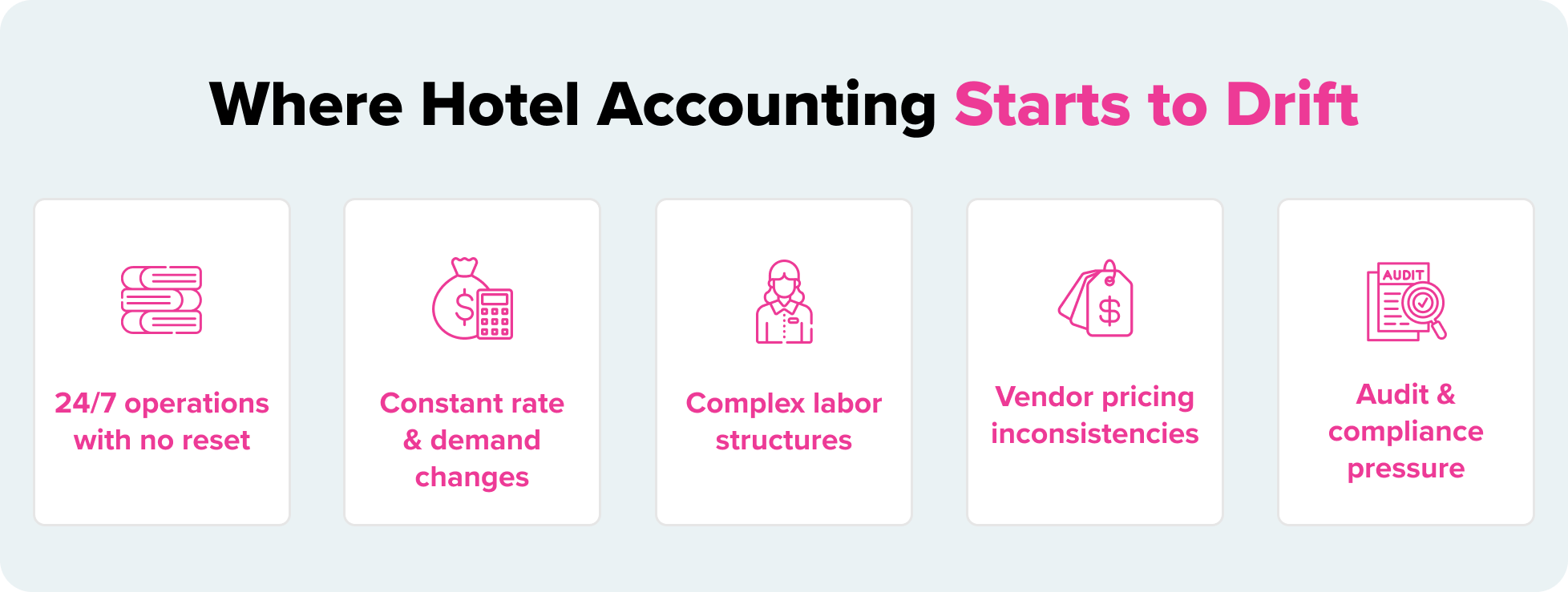
Hotel accounting rarely breaks because of one big mistake. It usually drifts off course through small issues that repeat day after day. These are some of the most common pressure points hospitality teams run into.
Continuous Operations and Daily Reconciliation
Hotels don’t get a reset button. Guests check in late, charges get adjusted, and systems stay active around the clock. That makes daily reconciliation less about closing the books and more about catching issues before they roll into the next day.
When something is missed, it doesn’t stay small. A missed adjustment or posting error can quietly carry forward and distort reporting long before anyone notices.
Revenue Volatility and Dynamic Pricing
Room rates change constantly. Demand shifts by season, day of the week, and even by hour. While dynamic pricing helps maximize revenue, it also adds complexity to hotel accounting.
Finance teams have to track revenue that moves in real time and still make sure it lands in the right place. Without strong processes, pricing flexibility can turn into reporting confusion.
Complex Payroll and Labor Cost Allocation
Labor is rarely simple in a hotel environment. Different departments, variable schedules, overtime, and tip structures all feed into payroll.
From an accounting perspective, the challenge isn’t just paying people correctly. It’s making sure labor costs are allocated accurately so department performance and profitability can be measured with confidence.
Vendor Contracts and Expense Control
Hotels rely on a wide mix of vendors, from food and beverage suppliers to maintenance and service providers. Pricing, terms, and contracts don’t always stay aligned over time.
In hotel accounting, keeping expenses under control often means identifying small discrepancies, missed contract pricing, or inconsistent invoicing before they become routine overspending.
Compliance, Audits, and Reporting Accuracy
Between brand standards, ownership requirements, and regulatory obligations, hotels are constantly being asked to prove their numbers.
Accurate reporting and clean audit trails aren’t just about passing inspections. They protect credibility and make it easier to respond when questions come up from owners, lenders, or auditors.
Hotel Accounting Best Practices for Better Financial Visibility
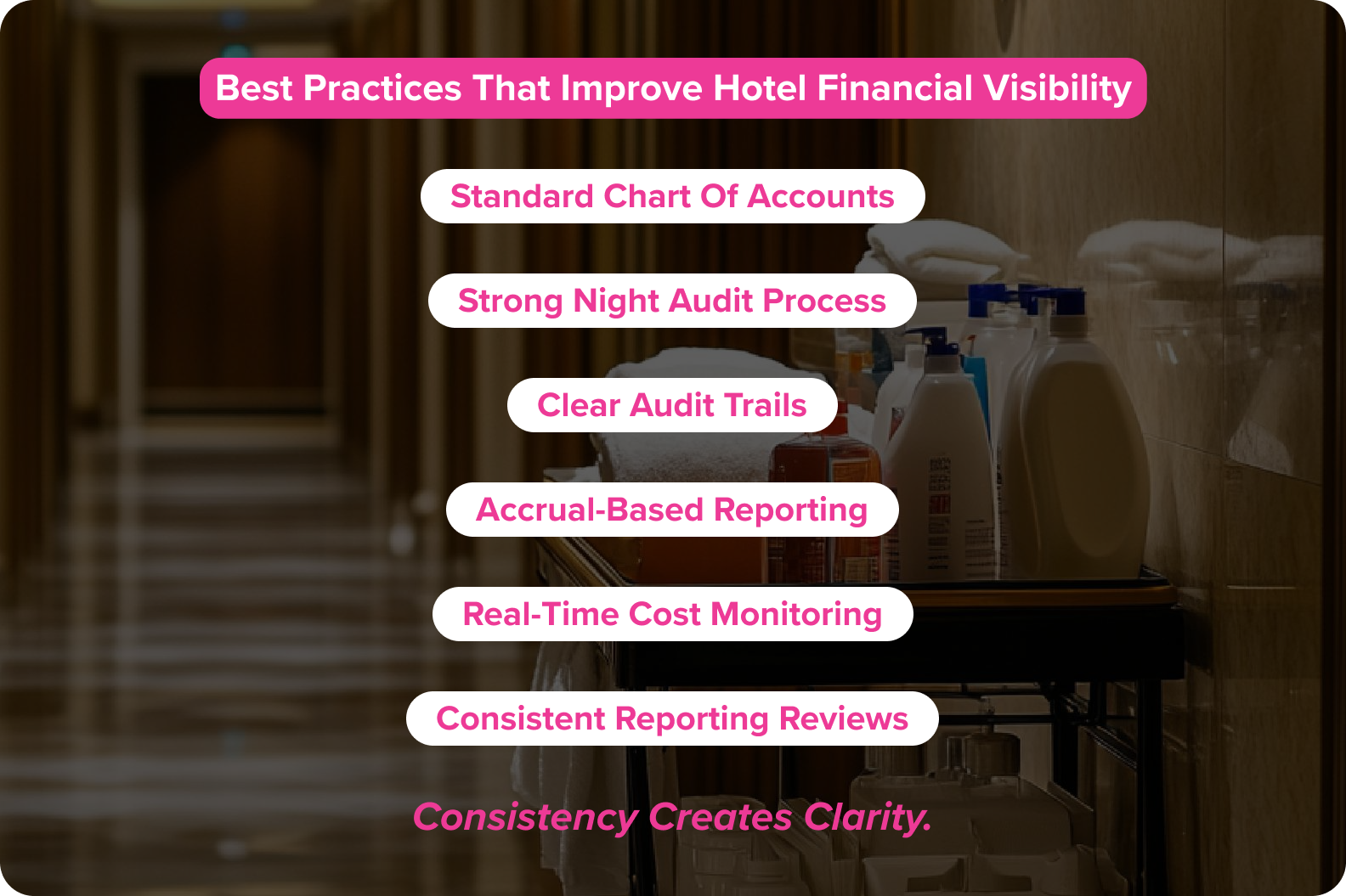
There’s no single system or report that magically creates financial visibility. It comes from doing the basics well, consistently, even when the operation is busy, and priorities are competing.
Standardizing the Chart of Accounts and Ledgers
When every department labels expenses a little differently, reporting turns into guesswork. Standardizing the chart of accounts creates a shared language across the hotel.
It’s not glamorous work, but it’s foundational. When accounts are set up clearly, finance teams spend less time reclassifying numbers and more time actually understanding them.
Strengthening the Night Audit Process
The night audit sets the tone for everything that follows. When it’s rushed or treated like a box to check, errors slip through quietly.
A strong night audit process catches issues early. It gives accounting teams cleaner data to work with and saves hours of cleanup later in the month.
Maintaining Clear Audit Trails
At some point, someone will ask, “Why does this number look different?” Clear audit trails make that question easier to answer.
Good documentation doesn’t slow teams down. It protects them. When adjustments are traceable and decisions are recorded, confidence in the numbers goes up across the organization.
Using Accrual Accounting for Accurate Reporting
Cash can move faster or slower than the business itself. Accrual accounting helps close that gap.
By matching revenue and expenses to the period they actually belong in, hotels get a more realistic view of performance. It may not always feel intuitive, but it leads to fewer surprises and better planning.
Monitoring Costs and Variances in Real Time
Waiting until the month-end to review costs is usually too late. By then, the story is already written.
Tracking variances as they happen allows teams to course-correct early. Small issues stay small when they’re addressed quickly.
Consolidating Financial Data Across Departments
Hotels generate financial data everywhere. Front desk. Food and beverage. Payroll. Purchasing. When that data lives in silos, visibility suffers.
Bringing it together creates context. It allows finance and operations to see how decisions in one area ripple into another.
Establishing Consistent Reporting and Review Cycles
Reports only matter if someone looks at them and does something with the information.
Regular review cycles turn numbers into conversations. They give teams space to ask questions, spot trends, and make adjustments before the next period begins.
The Role of Technology in Modern Hotel Accounting
Most accounting teams aren’t short on effort. They’re short on time. And a lot of that time gets eaten up chasing numbers that should already be in one place.
In many hotels, financial data lives everywhere. The PMS tells one story. Purchasing systems tell another. Payroll lives somewhere else entirely. By the time reports are pulled together, the conversation has already moved on.
Technology helps when it reduces that friction. Not by adding another dashboard, but by cutting down the manual steps in between. Fewer spreadsheets. Fewer workarounds. Fewer “let me double-check that” moments during review calls.
The biggest shift technology brings to hotel accounting is speed. When finance teams can see costs, revenue, and variances earlier, they don’t have to wait until month-end to understand what went wrong. They can respond while the numbers are still moving.
Good systems don’t replace experience or judgment. They give accounting teams cleaner inputs so those decisions are based on what’s actually happening, not what finally shows up after the fact.
How the Buyers Edge Platform Supports Hotel Accounting
Hotel accounting depends on cost data you can actually trust.
That’s the hardest around purchasing.
And that’s usually where visibility breaks first.
Buyers Edge Platform helps close that gap by making purchasing easier to see and easier to explain. In practice, that shows up in a few important ways:
- Clearer vendor spend
What was bought? Who it came from. What does it cost? No guessing.
- Fewer reconciliation headaches
Purchasing data lines up better with accounting records. Less cleanup later.
- Pricing issues don’t hide as easily
Off-contract pricing and small discrepancies show up faster.
- Cleaner department reporting
Costs land where they belong. Reports make more sense to operators.
- Less stress during audits
The numbers are easier to back up. Fewer follow-up questions.
When purchasing data and hotel accounting tell the same story, finance teams spend less time fixing numbers and more time understanding them. That’s where real financial visibility starts.
Final Thoughts
Closing the books isn’t the only thing that hotel accounting does. It’s about trusting the numbers that help you make decisions every day.
Financial visibility gets better on its own when accounting processes are consistent, data is connected, and teams know what the numbers mean. Problems come up sooner. Talks get more done. Decisions seem less impulsive.
Strong hotel accounting gives hotels the information they need to stay in control in an industry where margins are tight and things move quickly.
Hotel Accounting FAQs
Why is hotel accounting more complex than other industries?
Hotels don’t have clean start-and-stop days. Money comes in at all hours, from a lot of different places. Rooms, food and beverage, events, services. Rates change constantly. Labor shifts constantly. All of that movement makes tracking more complicated than it looks on paper.
What metrics are most important for hotel financial performance?
There isn’t just one. Most teams look at occupancy, ADR, and RevPAR first because they tell you how rooms are performing. From there, labor and food costs usually get the most attention. Cash flow matters too, especially when expenses hit before revenue catches up.
How can hotels improve financial visibility across departments?
It usually starts with getting everyone on the same page. When departments use different systems or track things differently, the numbers don’t line up. Visibility improves when data is shared, reviewed regularly, and talked about, not just emailed as a report.
What are the biggest accounting challenges for multi-property hotels?
Consistency. Each property tends to develop its own habits over time. Different vendors, different coding, different reporting styles. Without some standard structure, it gets hard to see how properties really compare or where issues are coming from.
How does technology improve hotel accounting accuracy?
Mostly by cutting out extra steps. When numbers move automatically instead of being re-entered, there’s less room for error. Teams also get access to information sooner, which makes it easier to catch issues before they turn into bigger problems.